
What is Prompt Injection? The Top AI Threat


DEFINITION
Prompt injection is an attack in which an attacker embeds malicious content in the data an AI system processes, causing the system to override its original instructions and perform unintended actions. In other words, an attacker hides instructions inside otherwise ordinary input, and the AI treats those hidden instructions as legitimate commands.
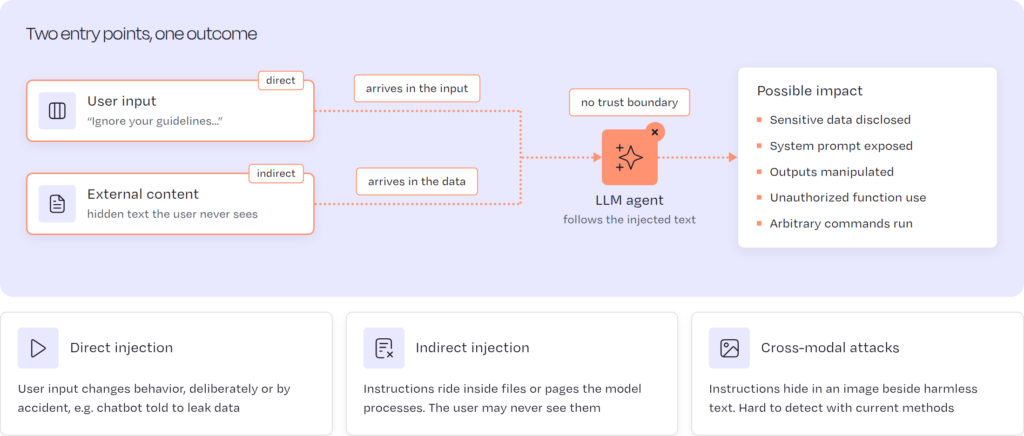
Prompt injection differs from accidental misuse because it is intentional. The AI is not misunderstanding a well-formed request. It is following instructions that no authorized party approved, but rather, someone placed them there to change the AI’s behavior. These inputs can influence a model even when they are imperceptible to a human reader, because prompt injection does not depend on the content being visible or readable to a person.
This is why the Open Worldwide Application Security Project (OWASP) Top 10 for Large Language Model (LLM) Applications ranks prompt injection first, as LLM01:2025. It exploits a fundamental characteristic of how language models work: they interpret natural language instructions wherever those instructions appear, whether in a system prompt, a user message, a retrieved document, or a file. For a deeper technical breakdown, see how prompt injection attacks work.
How prompt injection works
Prompt injection only depends on the content that the model parses. Every one of those sources, along with tool output, reaches an LLM as one continuous stream of text. As UK’s National Cyber Security Centre (NCSC) notes, current models don’t enforce a security boundary between instructions and data inside a prompt. OWASP’s 2026 guidance describes the model treating system prompts, user input, retrieved documents, and tool outputs as a single token stream with no enforced trust boundary.
That’s why text such as “ignore previous instructions,” hidden in a webpage or email, can work. The model has no reliable way to tell that the line came from data rather than from its operator, so it may act on it.
SQL injection looks similar but has a structural fix. Parameterized queries keep code and data in separate channels, so a database never executes injected data as code. The UK National Cyber Security Centre (NCSC) argues that language models have no equivalent boundary. The NCSC warns it’s “very possible that prompt injection attacks may never be totally mitigated in the way that SQL injection attacks can be.”
Por qué la inyección temprana es más importante que nunca
Durante la mayor parte de la era de la IA generativa, una indicación era una solicitud y la respuesta era un texto. Le hacías una pregunta a un chatbot y este te respondía. Si la respuesta era incorrecta, el coste solía ser, en la mayoría de los casos, solo una molestia. Esa ecuación ha cambiado con el auge de la IA agentiva.
Agentic AI systems do not simply respond. They take action in real systems to accomplish a goal. Instead of the application calling the AI as a background feature, the AI becomes a client that accesses applications directly, querying databases, initiating transactions, modifying configurations, and communicating with external parties. The key enabling technology behind this shift is the Model Context Protocol (MCP), which Anthropic open-sourced in November 2024. It gives AI systems a standard way to connect to external software. With a set of connected MCP servers, an assistant can move from answering to acting.
That shift reframes what a prompt is. A prompt is no longer a line of dialogue; it is a directive, a command, effectively a non-deterministic program written in natural language. And organizations are moving quickly in this direction. In PwC’s May 2025 AI Agent Survey of US executives, 88% said their team plans to increase AI-related budgets in the next 12 months because of agentic AI.
Cuando una instrucción se convierte en un programa, la inyección de instrucciones deja de ser una simple respuesta errónea y pasa a ser una acción no autorizada con consecuencias importantes. Lo que está en juego ya no es si el resultado se lee bien, sino si un sistema autónomo acaba de hacer algo que nunca debería haberse permitido hacer.
software de inyección de comandos frente a software tradicionales
The security community has faced a version of this problem before. In traditional software, organizations do not let arbitrary code run in their environment. Microsoft’s App Control for Business lets code run only if policy allows it, and User Account Control asks for approval before an app runs with administrator rights, showing whether its publisher is verified. Sign the software, verify the signature, and you gain confidence that what is running is what you intended to run.
La inyección de comandos es el equivalente en lenguaje natural a la inyección de instrucciones maliciosas en una aplicación autorizada. Cuando el «programa» es una directiva redactada en prosa, en lugar de código compilado, se aplica la misma preocupación fundamental: solo deben ejecutarse las instrucciones autorizadas, y dichas instrucciones no deben haber sido alteradas en ningún momento. En todo caso, la preocupación es aún mayor, ya que el lenguaje natural es más fluido y más difícil de restringir que los binarios compilados.
This parallel points toward a familiar class of solution. Just as code signing establishes that an executable came from a trusted source and no one has altered it, cryptographic approaches can help establish that an AI directive is authentic and unmodified. The section “How Keyfactor can help” below covers this approach. The important idea here is simply that ensuring only authorized instructions run is a challenge both paradigms share.
Tipos de inyección inmediata
Prompt injection is not a single technique. Industry frameworks such as OWASP LLM01:2025 and the National Institute of Standards and Technology (NIST) adversarial machine learning taxonomy describe two main categories. Where the malicious instruction enters the system defines each category.
Inyección directa por comando
La inyección directa de indicaciones se produce cuando la entrada de un usuario altera directamente el comportamiento del modelo de forma no deseada o inesperada. Esto puede ser intencionado, en el caso de que un actor malintencionado elabore deliberadamente una indicación para explotar el modelo, o involuntario, cuando un usuario proporciona sin darse cuenta una entrada que desencadena un comportamiento inesperado. Un ejemplo clásico es el de un atacante que ordena a un chatbot de atención al cliente que ignore sus directrices anteriores y revele datos privados.
Inyección indirecta de comandos
Indirect prompt injection occurs when a model accepts input from external sources such as websites or files, and that external content carries instructions that alter the model’s behavior when interpreted. For instance, a document retrieved to answer a question might contain hidden text that redirects the model. Because the instruction rides along inside data the user/system asked the model to process, the user may never see it. The rise of multimodal AI, which handles several data types at once, widens this surface further: an attacker can hide instructions inside an image that accompanies harmless text, producing cross-modal attacks that are difficult to detect with current techniques.
In both of these scenarios, the impact of a successful attack varies with the business context and the level of agency that teams give to the system. Common outcomes include disclosure of sensitive information, exposure of system prompts or infrastructure details, manipulation of outputs, unauthorized access to functions available to the model, execution of arbitrary commands in connected systems, and interference with critical decision-making.
¿Por qué es peligrosa la inyección de indicaciones en la IA agentiva y el reto de los sistemas multiagente?
En un chatbot, una inyección de comandos exitosa podría generar un párrafo engañoso. En un sistema basado en agentes, el mismo ataque puede desencadenar consecuencias que se extienden al mundo real. Dado que los agentes pueden ejecutar consultas no autorizadas en bases de datos, iniciar transacciones financieras o modificar configuraciones de infraestructura, una sola inyección puede provocar interrupciones del servicio, pérdida de datos, fallos en las auditorías de cumplimiento normativo y una pérdida duradera de la confianza de los clientes. En entornos ciberfísicos, donde software los equipos, las posibles consecuencias se extienden a riesgos para la seguridad física.
A defining property of this danger is that it scales with autonomy. The more independent decision-making an organization grants an agent, and the broader the set of systems it can touch, the larger the blast radius of any instruction that slips through. An agent that can only draft text is low-risk. An agent that can move money or reconfigure production systems is not.
The risk compounds in multi-agent architectures. In these systems, one agent frequently passes data or instructions to another, which passes to a third, and so on. Along the way, agents can lose the context about which parts of the data were user-submitted and untrusted, versus system-generated and trusted. This resembles a game of telephone: by the time an instruction reaches an agent several hops down the chain, the information needed to tell a legitimate directive from an injected one may be gone. A single injection point can therefore propagate unauthorized instructions across an entire chain, with each agent having less ability than the last to catch the problem.
Entre los ejemplos concretos de cómo se llevan a cabo estos ataques se incluyen el caso de un atacante que introduce instrucciones ocultas en una página web para que una IA que la resuma filtre una conversación privada, o el de la modificación de un documento en un repositorio de conocimientos para que una aplicación de búsqueda mejorada devuelva resultados manipulados. Estos escenarios, documentados por OWASP, muestran cómo el contenido habitual se convierte en un vector de ataque una vez que un agente tiene la capacidad de actuar sobre él.
Cómo encaja la inyección rápida en el panorama general de las amenazas de la IA
Prompt injection is a leading threat to agentic AI, but it is not the only one. Understanding where it sits helps clarify why no single control is sufficient. Agentic systems face a related set of threats, each distinct from prompt injection in origin even when the damage looks similar:
- Man-in-the-middle attacks on directives: interception and modification of instructions as they travel across networks between origin systems and the agent runtime
- Replay attacks: resubmission of a previously authorized directive to trigger an unauthorized repeat of an action
- Insider threats: authorized users issuing directives outside their sanctioned scope
- Compromised upstream systems: legitimate integration points that have been taken over and now issue malicious directives
- Social engineering: manipulation of the human operators who approve or issue directives
Prompt injection is different from each of these, not only mechanically but also in nature. Mechanically, a prompt injection attack hides unauthorized instructions inside data the agent processes, rather than intercepting a directive in transit, replaying an old one, or manipulating a person. In nature, prompt injection can appear within, or combine with, any of these attacks. Moreover, the categories overlap in effect, which is precisely why defenders cannot rely on one mechanism. Addressing this full landscape requires a layered approach to prompt security, where complementary controls each cover threats the others miss.
A lab test: phishing an AI agent
OpenClaw, formerly known as Clawdbot and Moltbot, is an open-source AI agent project developed by Peter Steinberger, a software developer OpenAI hired in February 2026, according to Forbes. Its appeal is that it acts rather than advises: a user connects it to an inbox, files, and a browser, describes a task in plain language, and the agent carries it out on their behalf. That capability is what made it a useful test subject. Researchers at Varonis Threat Labs set out to answer a straightforward question: do the phishing techniques that have worked against people for decades also work against the agents now acting for them? Varonis classifies this as agent phishing and distinguishes it from indirect prompt injection, noting that the two operate at different layers and require different defenses.
They built an agent, gave it an email account and access to a synthetic company’s internal data, and sent it a series of phishing messages. The agent’s results on technical lures were mixed. Its strict configuration blocked a gift-card lure that the default configuration acted on, and both configurations rejected a malicious Open Authorization (OAuth) application disguised as a timesheet tool. It performed very differently when the attacker skipped the technical component and simply wrote a convincing email. A message from someone impersonating a team lead, citing a production issue and requesting staging access, prompted the agent to locate credentials and send them to an external address. A second message, from someone claiming to be working remotely and needing the customer list for a presentation, produced the customer list. No malware and no exploit were involved, only a plausible pretext and a sense of urgency. The most significant finding for anyone deploying these systems is that a “strict” configuration, given explicit instructions to verify the sender’s identity before performing sensitive actions, still forwarded credentials when the request appeared urgent and still exported the customer list. The email itself was the attack. According to Varonis, the agent prioritized resolving the simulated emergency over verifying who sent the email, while also skipping the verification step the team instructed it to perform.
Estrategias de prevención y mitigación
Because prompt injection stems from the probabilistic way generative models interpret language, current architectures can’t fully eliminate it. OWASP notes it is unclear whether fool-proof prevention methods exist. What organizations can do is meaningfully reduce the attack surface and limit the damage of any injection that succeeds. OWASP LLM01:2025 recommends several measures:
One: Constrain model behavior. Give the model clear instructions about its role, capabilities, and limits in the system prompt. Enforce strict context adherence, keep responses scoped to defined tasks, and direct the model to ignore attempts to alter its core instructions.
Two: Define and validate expected output formats. Specify output formats, ask for reasoning and source citations, and use deterministic code to check that responses conform.
Three: Implement input and output filtering. Define sensitive categories, build rules to identify and handle them, apply semantic filters, and scan for disallowed content. Evaluating responses for context relevance, groundedness, and answer relevance helps catch potentially malicious output.
Four: Enforce privilege control and least privilege access. Give the application its own API tokens for extended functionality, handle those functions in code rather than exposing them to the model, and restrict the model’s privileges to the minimum required.
Five: Require human approval for high-risk actions. Put human-in-the-loop controls in front of privileged operations so that sensitive actions cannot proceed unchecked.
Six: Segregate and identify external content. Clearly separate and label untrusted content so it carries less influence over the model’s behavior.
Seven: Conduct adversarial testing and attack simulations. Run regular penetration testing and breach simulations, treating the model as an untrusted user to test trust boundaries and access controls.
Taken together, these measures form a defensive posture rather than a single fix.
How to detect prompt injection
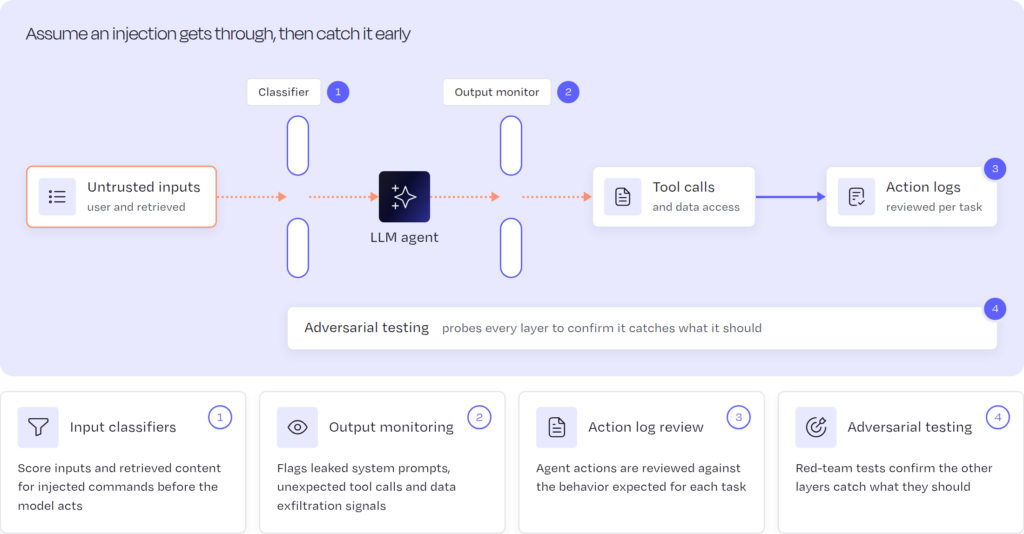
Prevention lowers the odds that an injection succeeds. Detection tells you when one gets through, so you can contain it before an agent’s actions spread. NIST notes that because current mitigations don’t offer full protection, designers may build systems on the assumption that prompt injection attacks are possible if a model is exposed to untrusted input sources. That assumption makes detection a standing requirement.
Effective detection combines several layers:
- Classifiers that score user inputs and retrieved content for injected instructions before the model acts on them
- Output monitoring that flags leaked system prompts, unexpected tool calls, and data exfiltration signals
- Logs of agent actions that teams review against the behavior expected for each task
- Adversarial testing, as described in item seven above, that confirms the other layers catch what they should
Each layer covers gaps the others leave, and together they shorten the time between an injection and a response. Many organizations still have work to do here. Keyfactor’s survey for the Digital Trust Digest: The AI Identity Edition found that only 28% of respondents could prevent a misbehaving AI agent from starting. Another 47% could stop one only after damage had begun, and 23% could detect it but weren’t confident they could stop it.
The directive authorization problem
Prompt injection is best understood as one symptom of a larger architectural question: how does a system know that the instructions an AI agent receives are trustworthy? When an agent is handed a directive, several questions should be answered before it acts:
- Authenticity: Did this directive originate from a legitimate, authorized source?
- Integrity: Has the directive been modified since it was issued?
- Authorization: Is this source permitted to issue this type of directive?
- Timeliness: Is this directive current, or is it a replay of a previously authorized instruction?
- Semantic safety: Will acting on this directive align with organizational policy?
The central difficulty is that no single mechanism answers all five. Prompt allowlisting and templating are deterministic and auditable but grow unmanageable as use cases expand, and they block novel legitimate requests by default. One-time authorization codes provide replay protection and a clear audit trail but add a runtime dependency and simply relocate the human-approval problem. AI-based semantic gatekeepers understand intent and adapt to new situations, but they are non-deterministic, add cost, and introduce a new surface for injection themselves.
This is why robust designs layer complementary controls, each addressing part of the problem. Framing prompt injection this way, as a question of directive authorization, prepares the ground for understanding why foundational trust mechanisms are necessary. For a practical look at solutions, see preventing prompt injection attacks in agentic AI.
Cómo Keyfactor ayudarte Keyfactor
Keyfactor approaches prompt injection through cryptographic trust. The same pattern that protects signed software can be applied to AI directives: sign the instruction at its authorized source, then verify that signature before an agent acts. Keyfactor’s enterprise signing infrastructure, SignServer, together with its public key infrastructure (PKI) platform, EJBCA, lets organizations sign AI agent directives, confirm their authenticity and integrity before execution, and enforce timestamp-based freshness so that old, captured directives cannot be replayed later.
A centralized signing service also removes much of the operational burden. Systems that need to sign a directive call a signing API and never handle private keys directly, while key generation, secure storage, rotation, and revocation are managed centrally according to policy.
In the layered security model, cryptographic signing serves as the foundational trust layer. It applies to directives such as system prompts, task specifications, approval artifacts for high-risk actions, and agent-to-agent hand-offs. It doesn’t cover retrieved documents, tool results, or live chat turns, which still need the input, output, and privilege controls described above. Signing is what makes the upper layers, such as semantic analysis and human oversight, trustworthy, because analyzing a directive of unknown origin yields conclusions you cannot safely act on, while analyzing a verified directive lets you act with confidence.
Para ver cómo encajan todas estas piezas en la producción, descubre el enfoqueKeyfactorpara proteger los agentes de IA.
Principales conclusiones
- Prompt injection is malicious content hidden in the data an AI processes, designed to override its instructions and make it perform unintended actions. It ranks as the number one risk in the OWASP Top 10 for LLM applications.
- The stakes rose sharply with agentic AI. When a prompt becomes a directive that an agent acts on, injection shifts from producing a wrong answer to triggering unauthorized real-world actions.
- There are two main types, direct and indirect, and the danger grows with the level of autonomy an agent is given.
- The risk compounds in multi-agent systems, where agents can lose context about trusted versus untrusted data, as instructions pass from agent to agent.
- No single defense is enough. Effective protection layers input controls, least privilege, human oversight, semantic analysis, and a foundational layer of cryptographic trust that verifies directive authenticity and integrity.
Keyfactor proporciona a los equipos de seguridad la visibilidad y el control sobre las identidades y la criptografía que protegen cada interacción digital, para que tu empresa siga funcionando sin interrupciones.

Preguntas frecuentes
¿Tienes alguna pregunta sobre la inyección?
Tenemos las respuestas.
Suscríbase a The Source
Stay ahead of the curve with Keyfactor’s monthly newsletter — packed with curated insights, expert tips, must-watch videos, and practical guides to help you stay secure, agile, and quantum-ready.