
What is Quantum Computing?


DEFINITION
Quantum computing uses quantum mechanics (such as superposition, entanglement, and interference) to process information in ways classical computers cannot.
For cybersecurity professionals, quantum computing represents both opportunity and risk. Quantum computing promises breakthroughs in optimization, simulation, and artificial intelligence. However, it threatens the public key cryptography behind every digital certificate, Transport Layer Security (TLS) connection, and code-signing operation your organization relies on.
Harvest Now, Decrypt Later attacks compound the urgency. In this scenario, adversaries capture encrypted data today with the intent to decrypt it once quantum computers mature. This article explains how quantum computing works, traces its evolution, and examines the engineering challenges that remain. It also details the threat to encryption and what security leaders must do to prepare.
How quantum computing works
Para comprender la amenaza cuántica que se cierne sobre la criptografía, hay que empezar por entender en qué se diferencian los ordenadores cuánticos de la infraestructura informática clásica.
How quantum computers process information
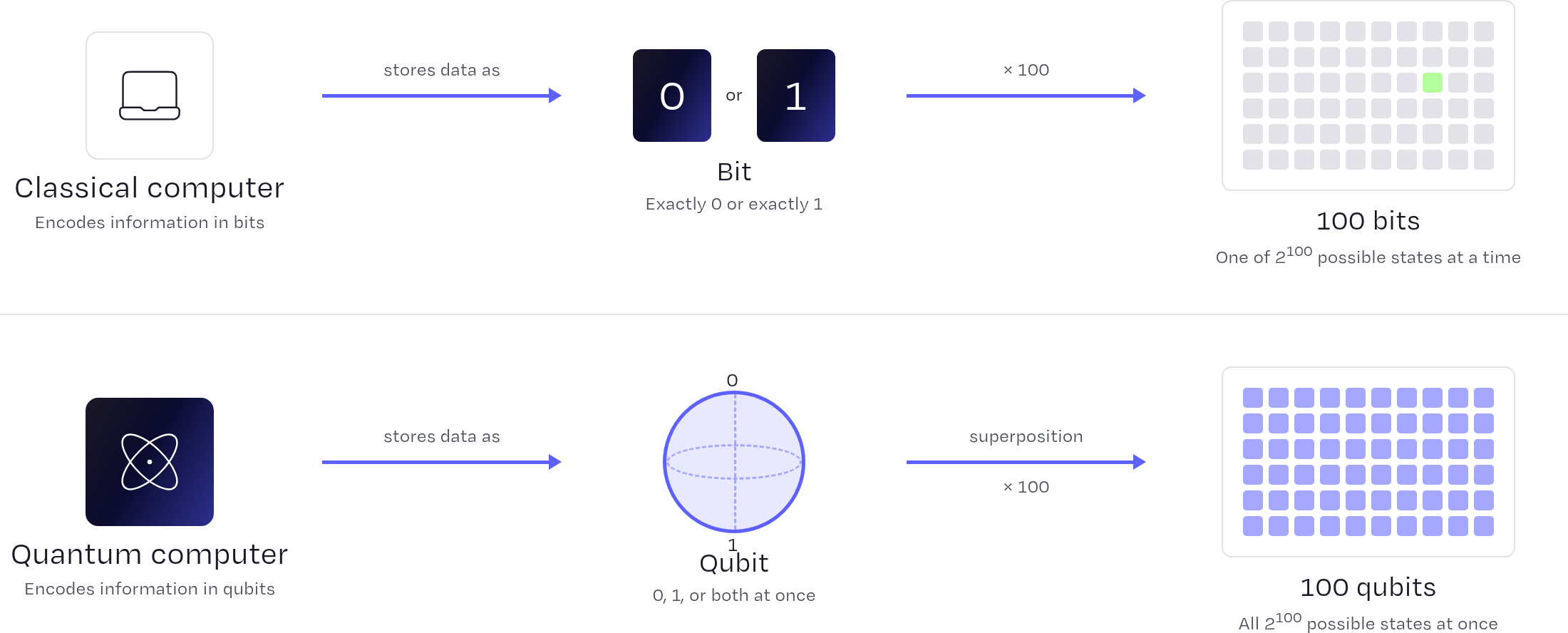
A classical computer encodes information in bits. Each bit exists in one of two definitive states: zero or one. Every operation a classical processor performs (e.g. every encryption routine, certificate validation, hash computation, etc.) reduces to manipulating streams of these binary values.
Quantum computers encode information using particles that show quantum properties (e.g. atoms, ions, or photons). These properties are not strictly binary, but rather, they are probabilistic. A quantum bit, or qubit, is an idealistic model of these characteristics. It can represent a zero, a one, or both simultaneously. This property, called superposition, is the foundation of quantum computing’s power.
The scaling implications are dramatic. A system with 100 classical bits can represent one of 2^100 possible states at once. A system with 100 qubits can represent all 2^100 states simultaneously, which opens the possibility of exploring a large solution space in parallel.
Superposition: the third state
Superposition is the quantum property that allows a qubit to exist in a probabilistic combination of states rather than a single definitive state. Consider a coin toss: while the coin spins through the air, there is an equal probability that heads or tails is facing up. Only when you catch the coin (or, in quantum lingo, when you measure it) does the outcome collapse to one result. A qubit in superposition behaves similarly, existing in a blend of possible states until measurement forces it into a definitive value.
This property enables quantum computers to evaluate all possible inputs to a problem simultaneously rather than sequentially. Imagine navigating a maze. A traditional computer would run all possible paths one after the other, testing each route until it finds the exit. A quantum computer can test all possible paths at once, arriving at a solution in a single run. If the algorithm yields the correct path with high enough probability (once you measure the state), then it provides an improvement in running time with respect to its classical counterpart.
This parallelism is not comparable to multithreading. Classical parallel processors still evaluate one state per thread. A quantum system in superposition evaluates a superposition of all states within a single computational operation, a fundamentally different model of information processing.
Entanglement: quantum correlation
Entanglement is the second foundational property of quantum computing. When two or more qubits become entangled, manipulating one qubit simultaneously affects its entangled partners, regardless of physical distance. This correlation makes it possible to coordinate the behavior of multiple qubits, enabling complex calculations that require interdependencies between variables.
Entanglement is also essential for quantum error detection and correction. Because quantum states are fragile (a challenge this article discusses in detail later) the ability to distribute information across entangled qubits and detect inconsistencies without directly measuring (and collapsing) the computation is critical to building reliable quantum systems.
The quantum advantage framework
Quantum computers are not universally faster than classical machines. They do not automatically find the right solution in one run. In practice, classical computers are faster for many routine tasks but need more steps for some complex operations. The advantage of quantum computing applies to specific categories of problems, particularly those involving large combinatorial search spaces, optimization, and (critically for cybersecurity) the problems associated with classical cryptography (such as factoring and discrete logarithm).
The quantum advantage operates along two dimensions. First, quantum computers can solve problems that are effectively impossible for classical systems regardless of time or resources. Second, they can solve existing problems faster at comparable cost, a concept that researchers sometimes call the “quantum economic advantage,” where the speed improvement justifies the investment in quantum infrastructure even when classical solutions technically exist.
Both dimensions are relevant to the cryptographic threat. Breaking RSA-2048 encryption is not impossible for a classical computer theoretically, however, it is impossible in practice because the time required exceeds the age of the universe. A sufficiently powerful quantum computer reduces that timeline from astronomical to practical.
Quantum computers vs. supercomputers
Quantum computers are not faster versions of supercomputers. They are a different kind of machine that suits a different class of problems.
A classical supercomputer links thousands of conventional processors, including CPUs and GPUs. It runs very large workloads in parallel, such as weather modeling, genomics, and AI training. It is reliable, mature, and fast at the broad range of tasks that make up most real-world computing. A quantum computer uses qubits and interference to attack a narrow set of problems, such as simulating quantum systems, certain optimization tasks, and the mathematics behind public key cryptography. It is not a general-purpose replacement.
This also explains the cryptographic risk. Adding more classical computing power does not meaningfully weaken RSA or elliptic curve cryptography (ECC), because the best known classical attacks scale poorly with key size. Shor’s algorithm changes that, but only on a large-scale, fault-tolerant quantum computer, which does not yet exist.
Future quantum systems are hybrid
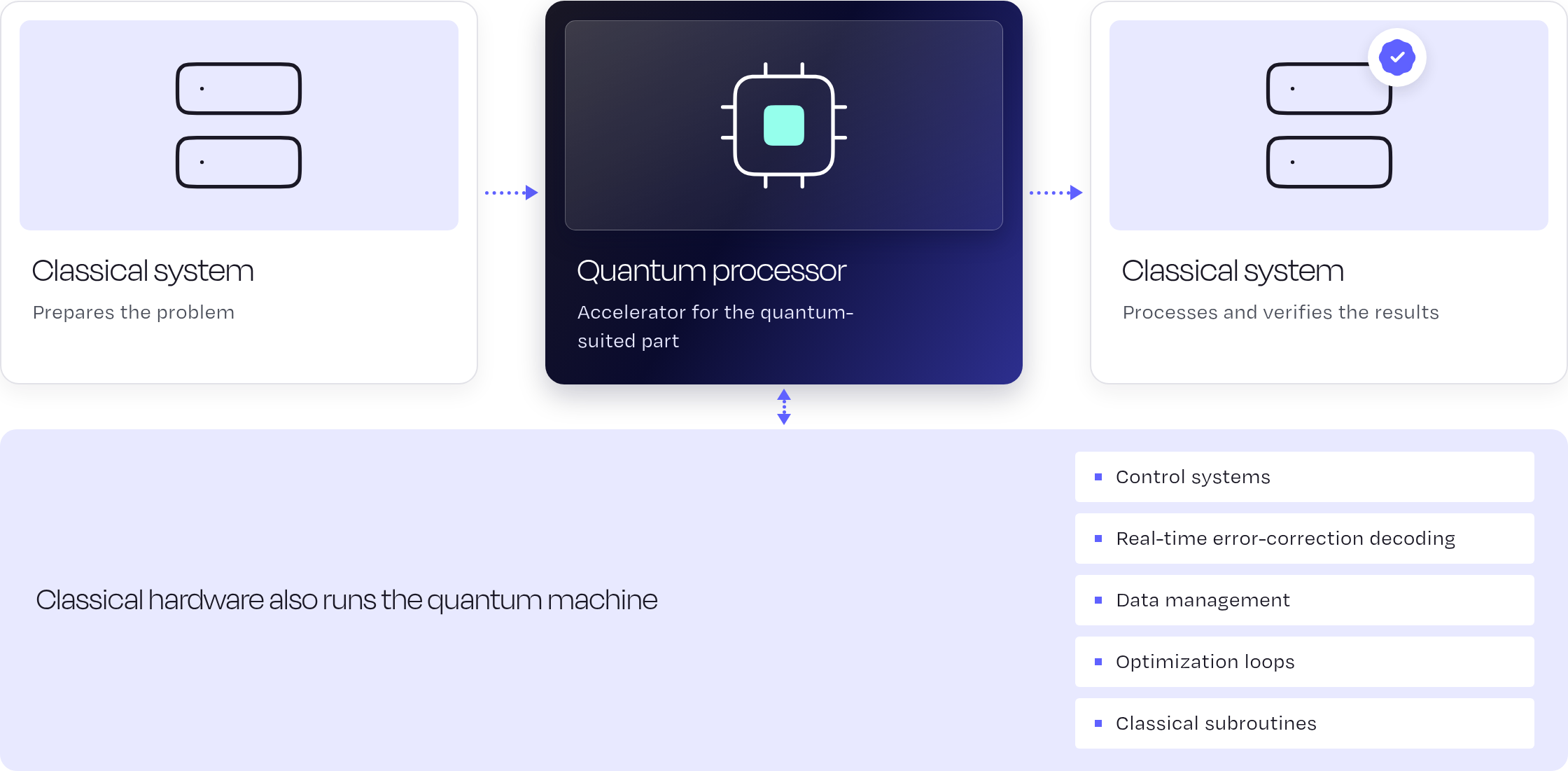
The future is hybrid, not winner-take-all. In hybrid quantum-classical computing, a quantum processor acts as a specialized accelerator inside a classical workflow, much as GPUs do today. Classical systems prepare the problem, send the quantum-suited part to the quantum processor, then process and verify the results. Classical hardware is also essential to running quantum machines. It handles control systems and the real-time decoding needed for quantum error correction.
Hybrid does not mean the quantum threat can wait. A hybrid architecture will still be able to run Shor’s algorithm once the quantum component is capable enough, and data harvested today stays exposed in the meantime. For security teams, the takeaway is to plan for quantum capability appearing as an accelerator inside existing infrastructure, not as a standalone event that is easy to spot.
Where quantum computing applies
While the cryptographic implications are the primary concern for security leaders, quantum computing’s broader applications explain why investment is accelerating and why the technology will mature. Quantum computers excel at simulating quantum mechanical systems, making them powerful tools for chemistry, molecular modeling, drug discovery, and materials science. In genetics and biological research, quantum computing addresses limitations that classical systems cannot overcome when modeling complex multi-gene interactions and mutations.
Quantum computing also has the potential to accelerate artificial intelligence training and inference, as the probabilistic nature of quantum computation aligns naturally with machine learning algorithms. Optimization problems – such as global supply chain routing, logistics, financial portfolio management, etc. – are a natural fit for quantum’s ability to explore massive solution spaces in parallel. And in precision measurement, the quantum research program of the National Institute of Standards and Technology (NIST) has demonstrated practical value through improvements in atomic clock precision and laser cooling technology.
The evolution and current state of quantum computing
Quantum computing did not emerge overnight. Its theoretical foundations stretch back more than a century, and its practical development has accelerated substantially since the turn of the century.
A brief history of quantum computing
The theoretical groundwork began in the early 1900s, when physicists including Max Planck, Albert Einstein, Niels Bohr, Werner Heisenberg, and John von Neumann established the principles of quantum mechanics that would eventually underpin quantum information science.
El salto de la física cuántica a la computación cuántica se inició en la década de 1980. En 1981, Richard Feynman propuso que los sistemas cuánticos podían simular fenómenos físicos de forma mucho más eficiente que los ordenadores clásicos. En 1982, Paul Benioff describió el primer modelo teórico de un ordenador cuántico. En 1985, David Deutsch había articulado el concepto de un ordenador cuántico universal capaz de simular cualquier sistema físico.
The 1990s brought two algorithmic breakthroughs with direct implications for cryptography. In 1994, Peter Shor published his algorithm demonstrating that a quantum computer could factor large integers exponentially faster than any known classical method. These are the mathematical problems whose hardness protects RSA, Elliptic Cuve Cryptography (ECC), and other widely deployed encryption schemes. In 1996, Lov Grover published a search algorithm offering quadratic speedup for unstructured search problems, with implications for symmetric key cryptography.
The 2010s saw the transition from theory to physical hardware. D-Wave released the first commercially available quantum computing system in 2011, using quantum annealers. IBM made quantum processors available through open-source cloud access in 2016. In 2019, Google claimed having achieved “quantum supremacy” by demonstrating a quantum processor completing a specific computation in 200 seconds that would have taken a much longer time to run on a classical supercomputer – Google estimated roughly 10,000 years, though IBM countered that an improved classical approach could do it in about two and a half days. By 2020, the field entered the Noisy Intermediate-Scale Quantum (NISQ) era, with tens, hundreds, or even thousands of physical qubits.
Starting in 2020, quantum computing shifted toward solving one of the most important challenges in scalability: quantum error correction. Major advances from Google Quantum AI, IBM Quantum, and others focus on improving qubit fidelity (reducing the probability of errors) and coherence times (increasing the time that the particles show quantum properties), resulting in better logical qubit construction. For more details, see the Quantum Error Correction subsection below.
The field has reached an inflection point. Universities have established dedicated quantum engineering degree programs, signaling workforce maturation. Federal agencies have formalized national security frameworks addressing quantum threats. NIST has published its first post-quantum cryptography standards, establishing the algorithms that will protect digital infrastructure in the quantum era.
Multiple technology approaches
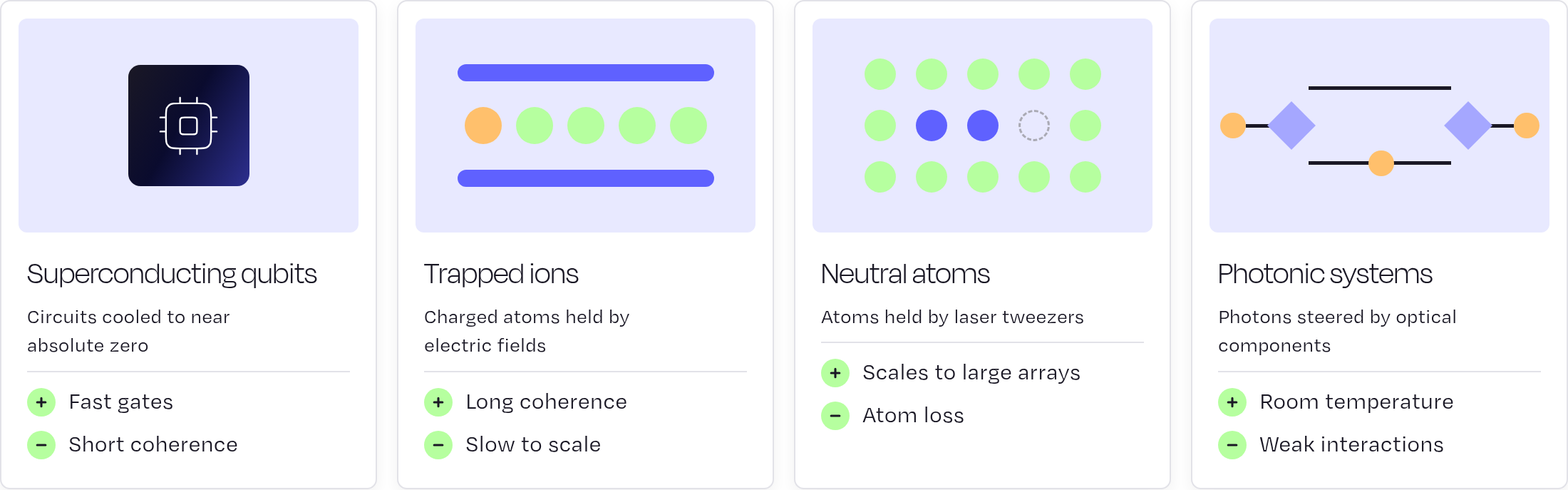
El campo de la computación cuántica está explorando simultáneamente varios hardware distintos: qubits superconductores, iones atrapados, átomos neutros y sistemas fotónicos, entre otros. Cada uno de ellos presenta diferentes ventajas, inconvenientes y retos de ingeniería.
As Andrew Wilson, lead of the quantum information science program at NIST, has noted: from a physics perspective, there is no fundamental reason why all of these approaches cannot work. The question is which will prove most practical for specific applications, and the answer may well be that different technologies serve different use cases, much as CPUs, GPUs, and specialized processors coexist in classical computing.
Using quantum systems in practice
Researchers have built and used small quantum computers for research, but none has demonstrated the ability to run Shor’s algorithm on significant input sizes. Current estimates suggest that breaking RSA-2048 would require roughly 1,200 to 1,400 error-corrected logical qubits, and up to 1,450 for 256-bit elliptic curve cryptography. Using today’s leading error correction schemes, that translates to several hundred thousand to about 1,000,000 physical qubits. These resource requirements have been falling steadily as algorithms and error correction improve.
This reality should not inspire complacency. As Andrew Wilson has observed, quantum computing is “now looking like a serious proposition rather than some sort of fantastical thing.” Quantum systems have demonstrated practical value in mathematical problems and physics simulations – domains that validate the underlying technology even as cryptographic applications remain on the horizon.
There remains a gap between theoretical algorithms and laboratory implementation that the field is actively working to close. Progress has been rapid, driven by significant public and private investment.
Engineering challenges and technical barriers
Several formidable engineering challenges govern the timeline from current quantum systems to cryptographically relevant quantum computers. Understanding these barriers provides important context for assessing the timeline on which quantum computers will threaten existing encryption.
Decoherence: environmental fragility
Qubits are extraordinarily sensitive to their environment. Vibrations, temperature fluctuations, and electromagnetic interference can cause qubits to collapse from their superposition state, a phenomenon called decoherence. Once a qubit decoheres, the system loses the information it carried, and the computation fails.
Stabilizing qubits (that is, maintaining their coherence) requires extreme isolation from the external environment. Engineers can do this via supercooled refrigerators, electromagnetic shielding, or vacuum chambers that substantially reduce external interference. The applicability of each technique depends on the hardware architecture. For example, superconducting qubits typically operate in supercooled refrigerators, while ion traps and neutral atom systems can operate at room temperature. These requirements impose significant constraints on where engineers can build and operate quantum computers. They directly limit how long a quantum computation can run before accumulated decoherence corrupts the result.
Quantum error correction
Errors in quantum computation are fundamentally different from errors in classical systems. Because of entanglement, errors in one qubit propagate and amplify through the circuit. More precisely, an error in a single qubit can cascade through entangled partners, corrupting an entire computation.
The strategy for managing quantum errors involves adding redundancy with additional qubits. The system distributes the information across entangled groups, and measuring error syndromes without disturbing the underlying computation. The result is a “logical qubit”, which is an error-protected assembly of many physical qubits that behaves like a single idealized, reliable qubit. Different quantum computing architectures are better suited to different error-correcting codes. Different approaches provide trade-offs between physical-to-logical qubit ratio, computational parallelism, clock speeds, etc.
Recent progress in logical qubit construction has been significant, but the overhead is still substantial. Current approaches require dozens to hundreds of physical qubits per logical qubit. This means that a quantum computer that needs thousands of logical qubits to break encryption may require from tens of thousands to millions of physical qubits. Google’s Willow demonstrated in 2024 that it’s possible to decrease errors exponentially with the number of physical qubits on superconducting quantum computers. Other approaches have a better physical-to-logical ratio, however, their capacity to scale remains unclear.
Traditional computing also requires error correction. Nevertheless, traditional systems have become so good at adjusting for mistakes that engineers rarely think about it. Quantum error correction has not yet reached that level of maturity.
Extreme refrigeration requirements
Most leading quantum computing approaches, particularly those based on superconducting qubits, require operating temperatures near absolute zero, that is, approximately -273.15 degrees Celsius. Achieving and maintaining these temperatures demands specialized dilution refrigerators that are expensive, energy-intensive, and difficult to scale.
Different quantum approaches have varying environmental requirements. Photonic and neutral atom systems operate at significantly higher temperatures, which may give them long-term advantages in practical deployment. The diversity of approaches is partly driven by the desire to find architectures that reduce or eliminate extreme cooling requirements.
Escalabilidad
Scaling quantum computers beyond current qubit counts introduces challenges that compound non-linearly. Linking multiple quantum chips requires maintaining coherence and entanglement across physical connections, and the control complexity grows exponentially with qubit count.
Energy consumption is an emerging concern. While there was early hope that quantum computers would require less energy than massive classical data centers, the reality is more nuanced: if it takes more energy to power smaller quantum computers than classical alternatives, that energy-efficiency benefit does not exist. The field is actively working to address this, but scalable, energy-efficient quantum computing remains an unsolved engineering problem.
La amenaza cuántica para la criptografía
For security leaders, quantum computing represents, above all, a risk that demands careful preparation. The same computational properties that make quantum computers powerful for optimization and simulation are equally powerful against the mathematical foundations of classical encryption.
How classical encryption works, and where it breaks
Most currently deployed public key cryptography relies on mathematical problems that classical computers cannot efficiently solve. The security of RSA (used for public key encryption and signing) depends on the difficulty of factoring a very large number into the two large primes that were multiplied to create it. Elliptic Curve Cryptography (ECC) relies on the discrete logarithm problem. These operations are easy to perform in one direction but computationally impractical to reverse with classical hardware, a property that experts often call “computational asymmetry”.
Shor’s algorithm, running on a sufficiently powerful quantum computer, solves both of these problems efficiently, directly undermining the computational asymmetry that RSA and ECC depend on. Every digital certificate, TLS handshake, code signature, and encrypted communication that relies on these algorithms becomes vulnerable.
As Chris Hickman, Keyfactor’s Chief Security Officer, has stated, the day will come when quantum computers are powerful enough to render traditional encryption obsolete. The question is when cryptographically capable quantum computers will arrive, and whether your organization will be prepared.
The “harvest now, decrypt later” attack
La amenaza cuántica va más allá de las futuras capacidades de descifrado, ya que los adversarios están recopilando datos cifrados con la intención de descifrarlos una vez que los sistemas cuánticos alcancen su madurez.
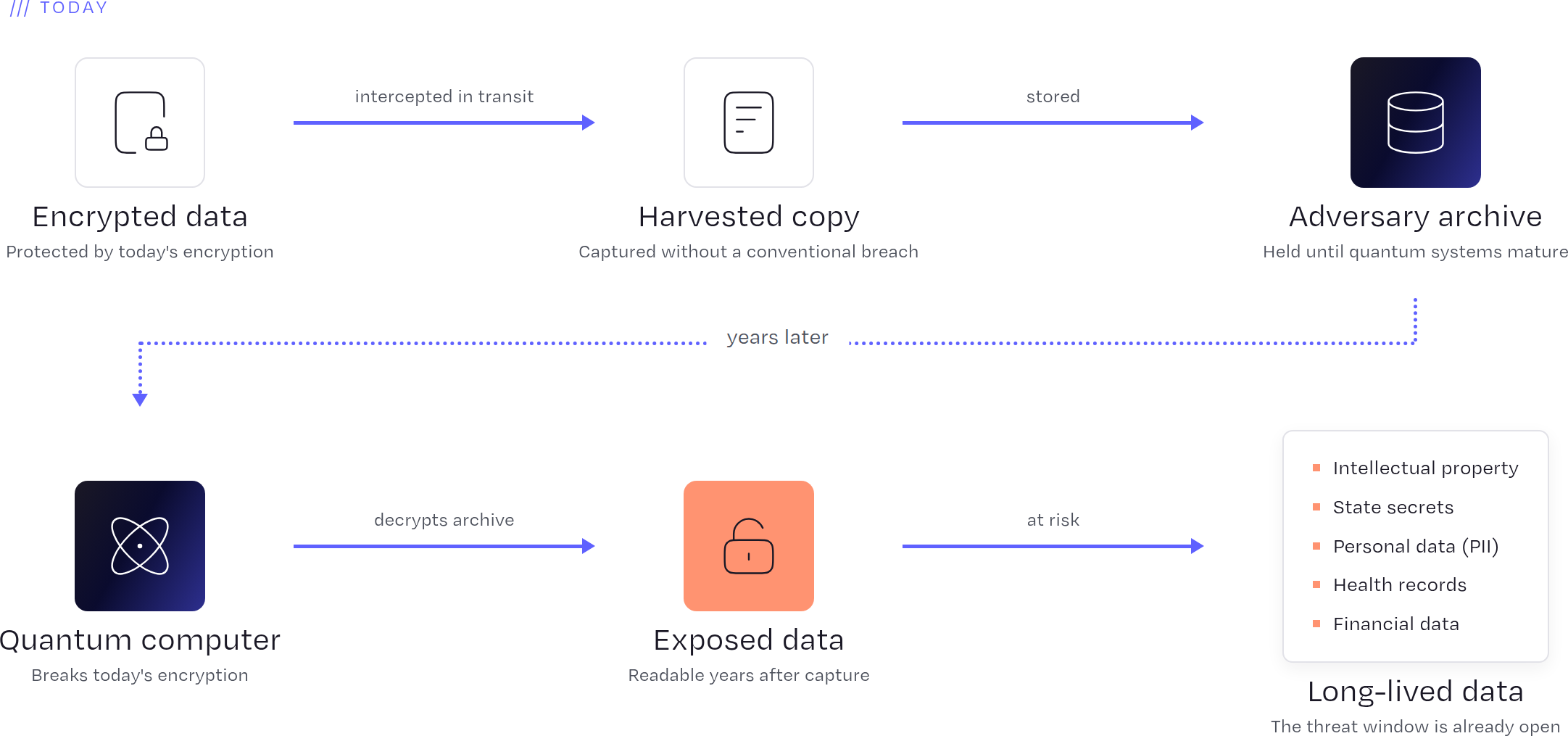
In a “harvest now, decrypt later” attack, adversaries capture encrypted data today, intercepting network traffic, exfiltrating encrypted databases, or copying stored communications. They do so with the intent to decrypt it once quantum computers are available. This attack does not require breaking into your systems in a conventional sense. It requires only the ability to capture encrypted traffic as it traverses networks.
Chris has been direct about this reality: we know adversaries are stealing data now for decryption later. For data with long-term value – intellectual property, state secrets, personally identifiable information, health records, financial data – the threat window is already open. Any encrypted data captured today with a long sensitivity shelf life is already at risk.
This is why acting on quantum readiness cannot wait for quantum computers to break encryption. The data you are protecting today must withstand threats that emerge years from now.
Post-quantum cryptography standards
The global response to the quantum threat centers on post-quantum cryptography (PQC) – a new generation of cryptographic algorithms designed to resist both classical and quantum attacks. NIST has published its first PQC standards, including ML-KEM (FIPS 203), ML-DSA (FIPS 204), and SLH-DSA (FIPS 205), with NIST expected to finalize more in upcoming years. This establishes the algorithms that will replace current encryption schemes.
PQC algorithms are mathematically different from RSA and ECC. They rely on lattice-based, hash-based, code-based, and other mathematical problems that researchers consider resistant to quantum attacks. The transition from current cryptography to PQC is complex and will take years, requiring changes to protocols, infrastructure, applications, and certificate management systems.
Cryptographic agility as a strategic imperative
The PQC transition underscores a broader requirement: crypto-agility, the ability to rapidly update cryptographic algorithms, protocols, and configurations across your infrastructure without rebuilding systems from scratch. Organizations that build cryptographic agility into their architectures now will be able to adopt PQC standards efficiently, and to adapt again when standards inevitably evolve.
The PQC migration is not just a threat response. It is an opportunity to build a more adaptable security architecture, one that can respond to future cryptographic challenges with agility rather than panic.
Why act now: the timeline
Researchers have not yet demonstrated cryptographically relevant quantum computers. Estimates for when they will arrive vary across research communities. In McKinsey’s conversations with tech executives, investors, and academics, 72% expect a fully fault-tolerant quantum computer by 2035, and 28% by 2040 or later. Not only do quantum computing capabilities keep increasing with developments in engineering, but the requirements for solving cryptographic problems have been consistently decreasing.
Specialized government and research entities have limited full-scale quantum computer deployment. But the threat model does not depend only on who has a quantum computer, but rather, it includes who is harvesting data today for future decryption.
Cryptographic migration is not a switch that teams can flip overnight. It requires years of planning, inventory, testing, validation, and phased deployment. Organizations that begin preparation now will have a manageable transition. Those that wait risk a compressed, high-risk migration under pressure.
Organizational readiness
Preparing for the quantum era is an operational imperative that security leaders who own Public Key Infrastructure (PKI), certificate management, and encryption infrastructure must drive.
Inventory, discovery, and risk prioritization
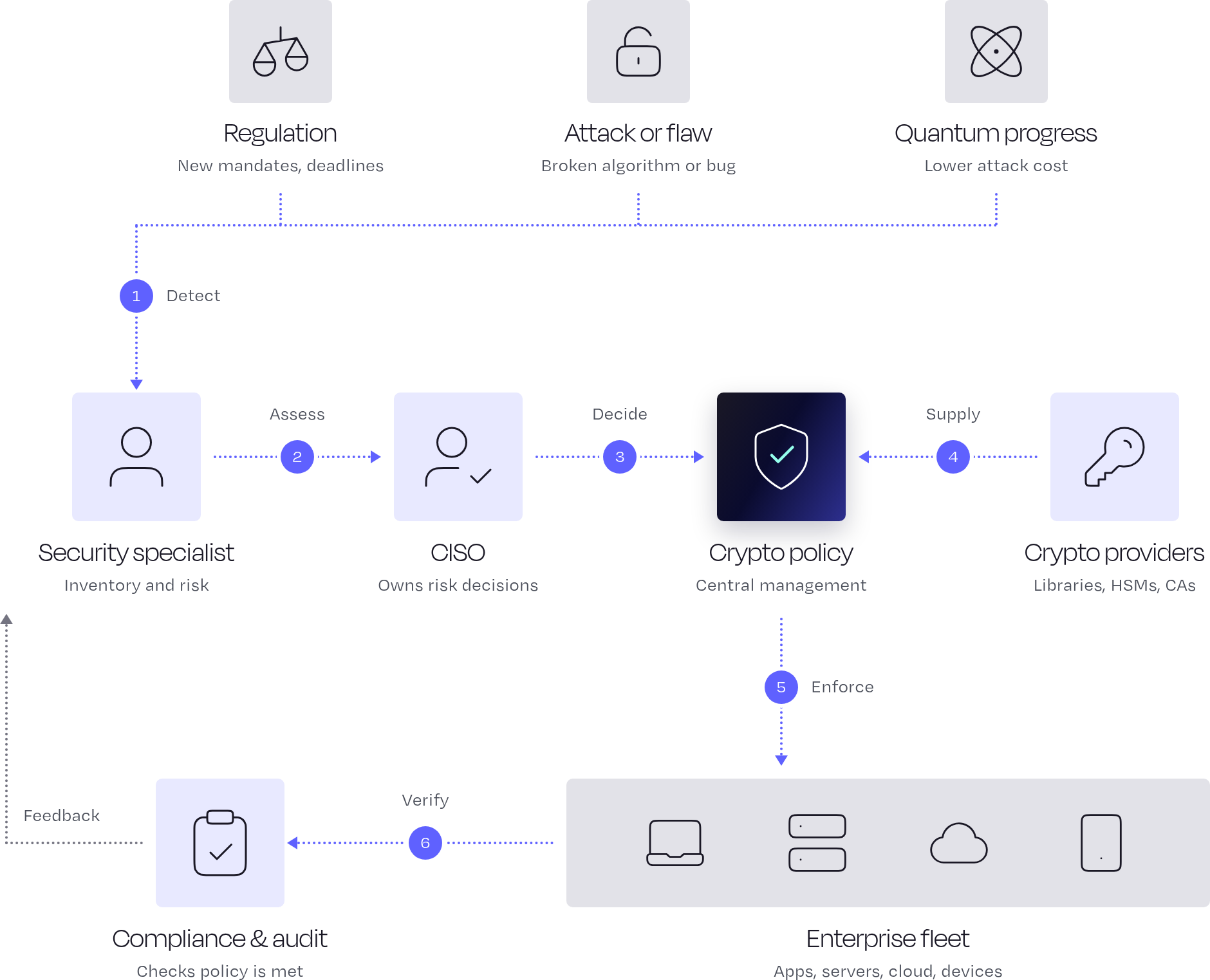
The first step in quantum readiness is visibility. You cannot protect what you cannot see, and most organizations lack a comprehensive inventory of their cryptographic assets, the certificates, keys, algorithms, and protocols deployed across their infrastructure.
Not all cryptographic assets face equal quantum risk. Security leaders should prioritize data with long shelf life, systems with extended deployment timelines, and assets subject to regulatory requirements. A risk-based approach allows security leaders to focus finite resources on the highest-impact transitions first.
Building a cryptographic asset inventory across cloud, continuous integration and continuous deployment (CI/CD), and device environments is the essential foundation for every subsequent readiness action.
Next steps for security leaders
Quantum readiness is a multi-year program, not a single project. The following actions establish the foundation for a successful transition:
- Conduct cryptographic asset discovery across cloud workloads, CI/CD pipelines, connected devices (IoT), and code-signing operations.
- Assess your posture against quantum-resistant standards. Evaluate which assets rely on algorithms vulnerable to quantum attack and which already align with PQC recommendations.
- Develop a prioritized PQC migration roadmap. Sequence transitions based on data sensitivity, regulatory exposure, and operational risk. Long-lived data and externally facing systems warrant early attention.
- Implement cryptographic lifecycle management. Automate the discovery, issuance, renewal, and revocation of certificates and keys to reduce manual overhead and ensure continuous compliance.
- Explore PQC through hands-on experimentation. Test quantum-resistant algorithms in non-production environments to build organizational familiarity and identify integration challenges early.
- Establish crypto-agility as an architectural principle. Design systems that can swap cryptographic algorithms without re-engineering applications or infrastructure.
To benchmark your current position, assess your organization’s cryptographic agility readiness as a starting point for building your migration roadmap.
What automating the foundation can deliver: evidence from a Forrester study
Quantum readiness starts with the same capabilities that make certificate management efficient: knowing what you have, and automating how teams issue, renew, and deploy it. Keyfactor commissioned Forrester Consulting to model the economics of that foundation in The Total Economic Impact™ of Keyfactor (April 2026).
Forrester interviewed five decision-makers at large banking, retail, software, and telecommunications organizations. It combined their experiences into a single composite organization with 40,000 employees, $20 billion in revenue, and about 400,000 certificates. The figures below show modeled results for that composite. They do not measure results for any individual organization.
| Modeled result (composite, three years, risk-adjusted) | Figure |
|---|---|
| Return on investment | 356% |
| Net present value | $9.9M |
| Payback | Under six months |
| Reduction in certificate-related incidents (Year three assumption) | 95% |
| PKI infrastructure and maintenance retired (Year three assumption) | 95% |
Interviewees described the same starting point many security teams recognize: teams managing certificates independently, limited visibility, and heavy manual effort for provisioning, renewal, and deployment. After consolidating on a single platform, they reported a single view of their certificate estates and engineers redirected from routine certificate work to automation and security.
Several themes bear directly on quantum readiness:
- Visibility comes first. A banking interviewee described the goal as knowing not just where certificates exist but which algorithms they use, so that externally facing systems teams can address first.
- Shorter lifespans raise the stakes. The study notes that public TLS certificate lifespans are heading toward 47 days by 2029, which multiplies renewal events and makes manual processes harder to sustain.
- Automation supports agility. Interviewees tied automation to their ability to adopt new algorithms and meet evolving requirements, though the study treats this as a qualitative benefit.
Every organization’s results will differ. Forrester’s model depends on certificate volume, how much is managed manually today, and the cost of incidents. You can adjust the study’s inputs to your own environment.
How Keyfactor supports quantum-safe readiness
La plataforma Keyfactorofrece a los responsables de seguridad las herramientas necesarias para prepararse para la era poscuántica, desde el análisis criptográfico hasta la migración a la criptografía poscuántica.
Keyfactor AgileSec
Keyfactor AgileSec is a cryptographic inventory platform that deploys sensors across code repositories, servers, endpoints, cloud environments, and network infrastructure. It discovers every certificate, key, and algorithm in use. Automated risk scoring identifies deprecated algorithms, insecure key sizes, and assets requiring PQC migration. AgileSec integrates with certificate lifecycle management, governance, risk, and compliance (GRC), information technology service management (ITSM), and configuration management database (CMDB) systems to turn cryptographic visibility into action across your security stack.
Keyfactor Command
Keyfactor Command provides certificate lifecycle management at scale, inventorying certificate authorities from multiple sources and enabling continuous detection, cataloging, and management of certificates across hybrid environments. A 2026 Forrester Total Economic Impact study commissioned by Keyfactor found a composite organization gained 356% return on investment (ROI) and $9.9 million net present value (NPV) over three years. Command gives security leaders the operational foundation to execute cryptographic transitions systematically.
Laboratorio PQC
Keyfactor’s PQC Lab offers open-source toolkits, free trial environments, and educational resources that enable security teams to experiment with quantum-resistant algorithms in a hands-on setting. PQC Lab is designed to help organizations move from awareness to action, building practical readiness for the quantum transition.
Keyfactor gives security teams visibility and control over the identities and cryptography that secure every digital interaction, so your business keeps running uninterrupted.
Preguntas frecuentes
Got quantum computing questions?
We’ve got answers.
Suscríbase a The Source
Stay ahead of the curve with Keyfactor’s monthly newsletter — packed with curated insights, expert tips, must-watch videos, and practical guides to help you stay secure, agile, and quantum-ready.