



Finishing your first post-quantum cryptography (PQC) migration wave is a real milestone. But standards, vendors, and architecture keep moving. Quantum computing is not the only threat. Cryptanalysis is advancing faster than ever before with the help of AI. Consequently, cryptographic algorithms will continue to change. PQC readiness Stage 5, continuous resilience, is how you stay ready through all of it.
Stage 5 is the last step in the five stages of PQC readiness. Its goal is simple: build cryptographic agility into your processes so you can swap algorithms without disruption, now and for whatever comes next.
In this post, you will see where Stage 5 fits, what continuous resilience looks like in practice, and six signs you’ve reached it. You’ll also get practical ways to keep readiness from slipping.
Where Stage 5 fits in the PQC readiness journey
Stage 5 is the outcome of the four stages before it. The quantum readiness journey starts with understanding your cryptographic landscape and ends with modernized cryptography across your organization.
- Stage 1, Awareness and Alignment, focuses on aligning teams and ownership for a migration that takes years.
- Stage 2, Discovery and Planning, focuses on discovering every certificate, key, and algorithm to set a baseline.
- Stage 3, Risk Prioritization, focuses on prioritizing by risk using data sensitivity, exposure, and shelf life.
- Stage 4, Agility and Automation, focuses on automating cryptographic operations so teams share one playbook that scales.
- Stage 5, Continuous Resilience, focuses on maintaining effective controls and migration patterns as your environment changes.
You can explore many of these steps hands-on in PQC Lab.
From Stage 4 to Stage 5: what changes
Stage 4 puts your plan into motion and makes what works repeatable. Teams standardize migration patterns, coordinate dependencies, and strengthen monitoring and governance. You know it’s working when those patterns, monitoring, and governance extend beyond the first wave of migration.
Stage 5 keeps it working as everything around it changes.
PQC migration is incremental and multistep, necessitating agility and governance. In our guide to cryptographic agility, we argue that manual updates fail at scale, so automated, policy-driven management becomes necessary.
Keyfactor’s PQC migration guide draws the same line. Deployment and lifecycle management lead to ongoing evolution. The guide frames migration as a continuous risk management process that unfolds over the years.
That is the Stage 5 shift: migration work becomes an operating discipline built on crypto-agility. This is a final, permanent stage that prevents your effort from deteriorating and turns your cryptographic infrastructure into the resilient, reliable component it is supposed to be.
What does continuous resilience mean at PQC readiness Stage 5?
At this stage, your focus moves to staying ready as standards, vendors, architectures, and risks change.
In practice, PQC readiness transforms into cryptographic risk management, becoming part of how you handle all challenges to your cryptography. You keep controls effective, catch regression early, and adapt migration patterns as your environment evolves.
Compare that with where many programs start: PQC treated as a one-time project with no governance. Treating this as an ongoing process helps the work endure beyond the first migration.
Why will algorithms change again?
Because “quantum-ready” is a moving target. Standard bodies continue to finalize and revise post-quantum algorithms, and today’s preferred choices may be deprecated as research matures. Moreover, quantum computing is not the only threat to cryptography. Cryptanalysis continues to advance, and AI is accelerating progress in this area, increasing the likelihood of further challenges and migrations.
During quantum migration, many organizations also pass through hybrid stages, pairing classical and post-quantum algorithms before moving to pure PQC. Keyfactor’s PQC migration guide recommends tracking those hybrid deployments, so you don’t miss the later move.
Vendor roadmaps, new architectures, and new regulations add even more change. Each one is a reason to revisit priorities and a reason why crypto-agility matters more than any single algorithm choice.
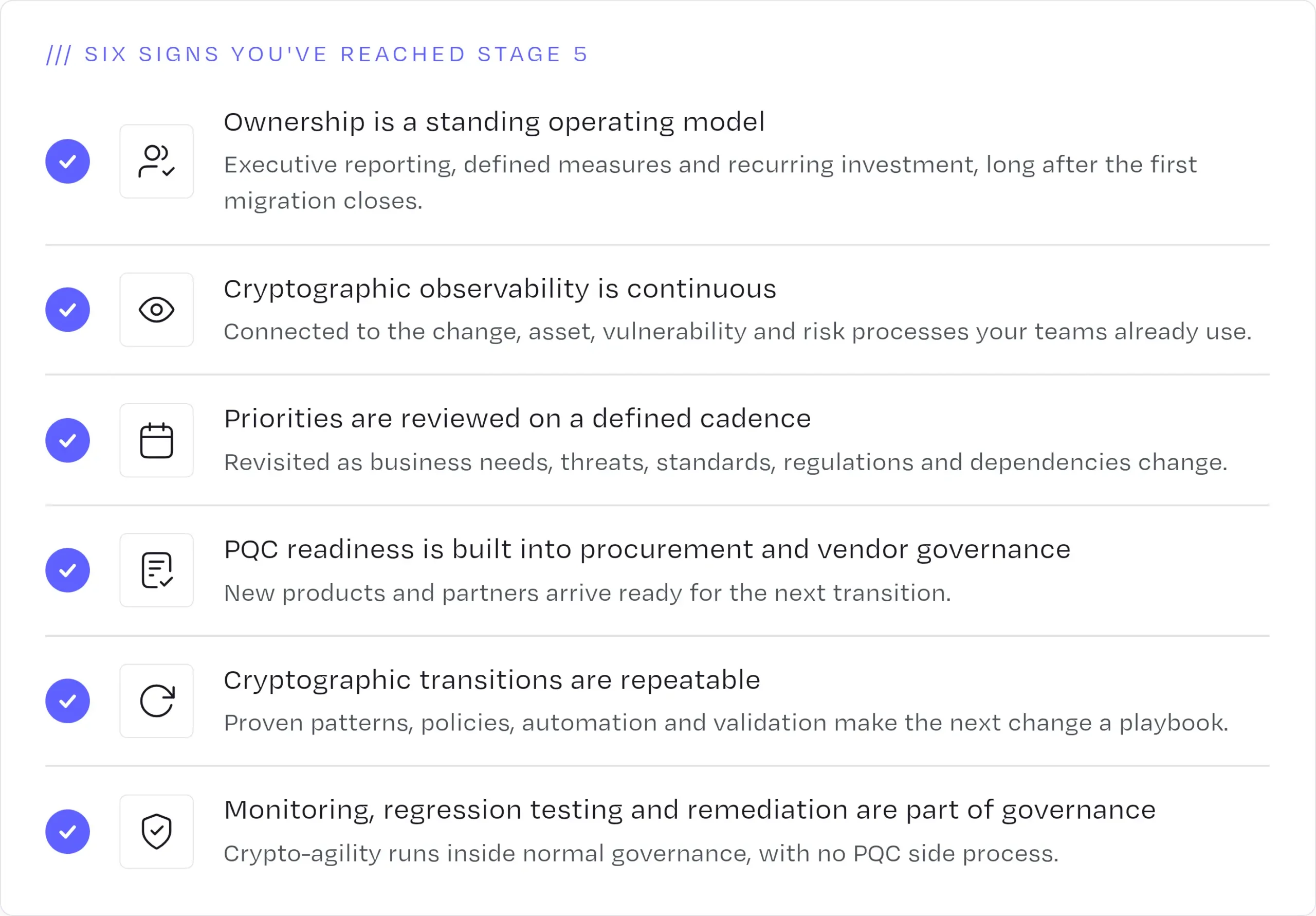
Six signs your organization has reached Stage 5
Each sign below reflects the most mature behavior in [the six dimensions of PQC readiness]([URL: PQC Assessment blog]). Use them as a quick checklist for your program.
Ownership is a standing operating model
PQC and crypto-agility live inside an ongoing operating model, with a dedicated owner, executive sponsorship, defined measures, and recurring investment. Ownership doesn’t end when the first migration project closes; it persists through the entire post-quantum journey.
Cryptographic observability is continuous
Cryptographic observability connects to the change, asset, vulnerability, and risk management processes your teams already use. It builds on continuous cryptographic discovery, where automated scans regularly find new or changed cryptographic use.
Priorities are reviewed on a defined cadence
You revisit priorities on a set schedule as business needs, threats, standards, regulations, and dependencies change. That keeps risk-based prioritization current instead of frozen at the time you first ranked systems.
PQC readiness is built into procurement and vendor governance
Readiness shows up in procurement standards, architecture decisions, vendor governance, and lifecycle planning. New products and partners arrive ready for the next transition, so you aren’t retrofitting them later.
Cryptographic transitions are repeatable
Proven patterns, policies, automation, and validation let teams repeat transitions across systems. This is where automation and crypto-agility pay off, because the next algorithm change follows a playbook you’ve already used.
Monitoring, regression testing, and remediation are part of governance
Continuous monitoring, regression testing, and remediation sit inside normal security and technology governance. Crypto-agility becomes part of how the organization runs, so PQC doesn’t need its own side process.
How to keep readiness from slipping
Readiness usually slips quietly, one configuration at a time. To stay ahead, define how you’ll track progress, manage exceptions, catch regression, and adapt as cryptography changes.
Mature programs move past manual check-ins. Owners report progress and exceptions on a cadence; then dashboards, controls, and workflows automatically surface regressions and policy exceptions to those owners.
Discovery needs to keep running, too. As Keyfactor’s PQC migration guide notes, discovery isn’t a one-time activity, because systems and configurations keep changing.
The same guide flags dynamic algorithm negotiation as a risk to watch since it can open the door to downgrade and confusion attacks. Careful protocol design and continuous monitoring help you close that gap.
What does cryptographic regression look like?
Cryptographic regression happens when remediated systems drift back to weak or noncompliant cryptography. Common examples include:
- A new service deployed with a legacy RSA-only configuration
- A vendor update that re-enables a deprecated cipher suite
- A hybrid certificate profile left in place after policy moves on
- A policy exception that never expires
Each one is easy to miss by hand. Missing one can leave your infrastructure vulnerable to downgrade attacks. Continuous monitoring tied to clear ownership makes them easy to catch.
Which metrics can show readiness is holding?
The right metrics depend on your environment and governance model. Here are a few suggestions to consider:
- Percentage of cryptographic assets under continuous discovery
- Number and age of open policy exceptions
- Time to detect and remediate regressions
- Percentage of priority systems on approved algorithms
- Percentage of new vendor contracts with PQC readiness requirements
- Time to roll out a policy change across systems
Watch trends over time. Direction tells you more than any single snapshot.
What progress looks like at Stage 5
Progress at Stage 5 means your controls and migration patterns keep performing as the environment changes. When a standard shifts or a vendor ships an update, you handle it through governed, repeatable change rather than a fire drill.

PQC READINESS ASSESSMENT
How ready is your cryptography, really?
Cómo Keyfactor ayudarte Keyfactor
Stage 5 depends on two things: knowing what cryptography you have right now and enforcing policy across it automatically. Keyfactor’s crypto-agility solutions are built around both.
Keyfactor Command automates certificate lifecycle management and enforces your migration policies automatically when they change. It also inventories post-quantum and hybrid certificates, helping you track hybrid deployments as you move toward pure PQC.
Keyfactor cryptographic discovery keeps your inventory continuous, so new or changed cryptographic use doesn’t go unnoticed. Together, they give you the visibility and control that continuous resilience requires.
Other parts of the platform support specific transitions. EJBCA issues quantum-resistant and hybrid certificates for pre-production testing, SignServer supports PQC code signing, and Bouncy Castle APIs bring PQC to the code level.
To see it in action, take the free test drive in PQC Lab. In a sandbox, you can explore quantum-resilient certificates, code signing, and lifecycle management in minutes, with no setup.
Not sure where to begin? Start the PQC readiness assessment, or choose Talk with a PQC expert to discuss discovery, prioritization, testing, and migration.
For more Stage 5 reading, explore these resources in PQC Lab:
- The Trust Control Plane: Operating Trust as a System
- IBM + Keyfactor: Cryptographic Modernization, Enabling Trust, Compliance and Resilience
Keep your cryptography ready for whatever comes next
Continuous resilience turns PQC readiness into everyday capability. When cryptographic change is governed, visible, and repeatable, you’re ready for the next algorithm, standard, or vendor shift.
Ready to keep going? You can revisit the full five stage framework, explore PQC Lab, or Request a Demo to see Keyfactor’s crypto-agility in action.
Preguntas frecuentes
Got PQC Stage 5 questions? We’ve got answers.
Suscríbase a The Source
Stay secure with Keyfactor's monthly newsletter, packed with expert insights and practical steps for quantum-readiness.
Continuar leyendo

Ventajas y desventajas de la informática cuántica: lo que debes saber
Leer más
Preparación cuántica: Por qué el día Q es un mito y 5 medidas inmediatas
Leer más