


Ask a security team where its quantum-vulnerable cryptography lives, and the honest answer is often “everywhere.” It sits in certificates, keys, libraries, devices, and vendor platforms and products. However, very few organizations have a current map of it.
That’s why the second stage of post-quantum cryptography (PQC) readiness, Discovery and Planning, matters so much. You can’t migrate what you can’t see. Stage 2 is where you find the keys, certificates, algorithms and protocols across your environment, benchmark your readiness, and build the migration plan.
This post is the second deep dive in our series on the five stages of PQC readiness. It walks through four steps that turn the discovery and planning stage into a roadmap. You’ll also find tools and resources from the Keyfactor PQC Lab.
Where does Stage 2 fit on the road to quantum resilience?
PQC readiness is a phased journey. It starts with understanding your exposure to quantum adversaries and ends with modernizing the cryptography your business depends on. In this model, each stage builds on the one before it.
In Stage 1: Awareness and Alignment, you secure buy-in, establish ownership of the process, and begin cryptographic discovery in select locations. Stage 2 expands the work started in the first stage by asking a few concrete questions: Where does quantum-vulnerable cryptography exist? Who needs to be involved? Which dependencies can affect the execution and delivery of your plans?
At this point, you’re building a clear picture. The goal is a fact-based baseline you can act on, so every later decision starts from evidence.
Signs you’ve arrived at Stage 2
You’ve likely reached Stage 2 if these sound familiar:
- An individual or working group is coordinating the effort, with executive sponsorship and funding in place.
- Your team has started discovering high-value or high-risk systems, but the process is still mostly manual.
- Your team is mapping the vendor, hardware, software, and service dependencies that matter most.
Step 1: Build visibility into your cryptographic exposure
Discovery is the foundation of every PQC decision that follows. Without it, prioritization is guesswork and timelines are hopeful estimates.
Focus initial discovery on your highest-risk areas: sensitive data, data that must remain protected over the long term, public-facing systems, and components subject to regulatory requirements. This helps surface the most important findings early.
Discovery maturity typically progresses in three steps:
- Limited visibility: You don’t have a reliable view of where vulnerable cryptography is used.
- Initial discovery: You’ve begun targeted, mostly manual discovery of known high-value systems, giving you an initial view of exposure.
- Validated visibility: You have a validated view across priority systems, with ownership, business context, and key dependencies mapped.
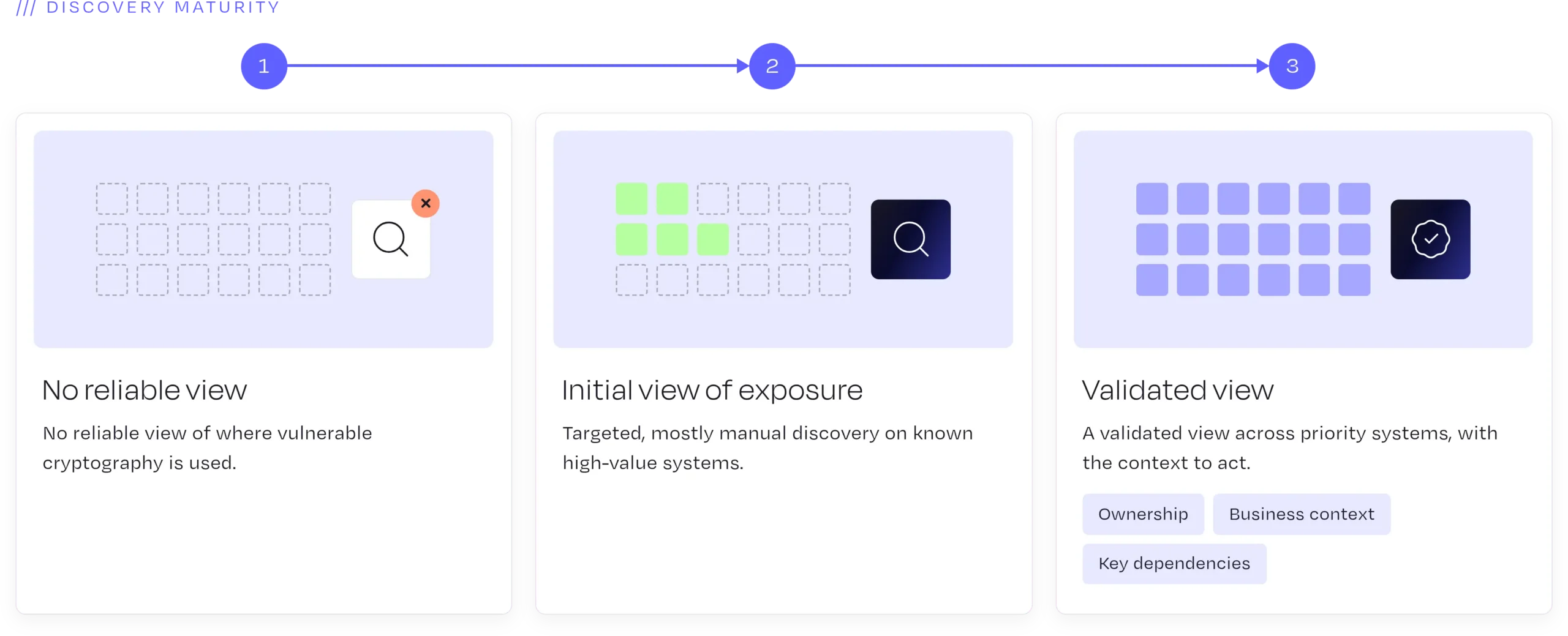
Aim for that third level in Stage 2. It tells you what cryptography you have, which team is responsible for it, why it matters to the business, and what relies on it.
How do you find quantum-vulnerable cryptography?
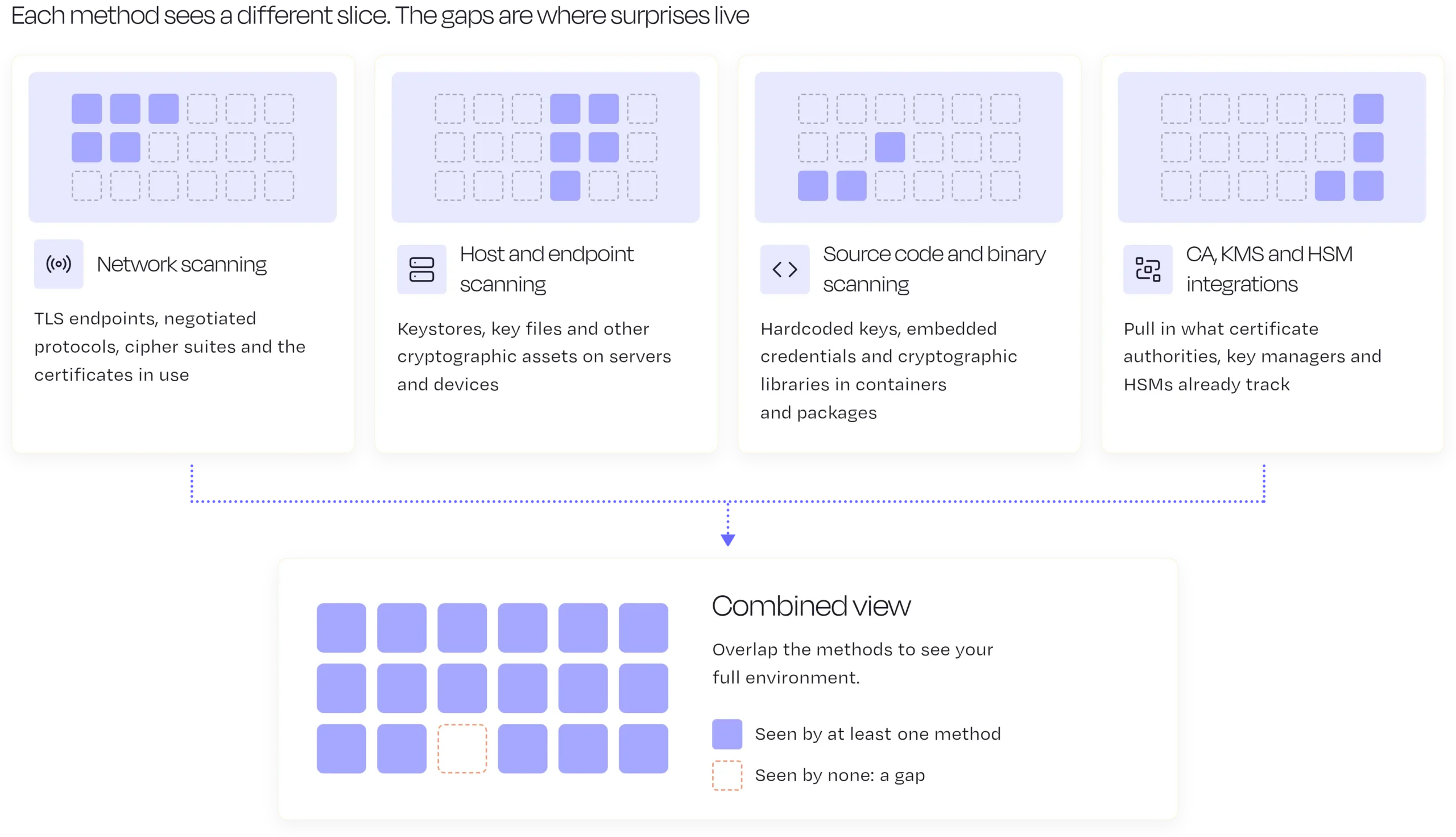
It’s important to use more than one discovery method. Each method sees a different slice of your environment, and the gaps between them are where surprises live. The goal is to minimize the number of remaining gaps.
- Network scanning reveals Transport Layer Security (TLS) endpoints, negotiated protocols, cipher suites, and the certificates in use.
- Host and endpoint scanning finds keystores, key files, and other cryptographic assets on servers and devices.
- Source code and binary scanning catches hardcoded keys, embedded credentials, and cryptographic algorithms and libraries in containers and packages.
- Integrations with certificate authorities, key management systems, and hardware security modules (HSMs) pull in what those systems already track.
Record findings in a consistent format. A cryptographic bill of materials (CBOM) applies the software bill of materials idea to cryptography. It is a static list of algorithms, key sizes, certificates, libraries, and their uses, so findings remain comparable across teams. A cryptographic asset inventory takes this idea to a new level by proactively scanning for cryptographic assets across the cryptographic infrastructure.
For a practical walkthrough, read our guide on how to build a cryptographic asset inventory. It covers cloud environments, continuous integration and continuous delivery (CI/CD) pipelines, and devices.
Where RSA and ECC tend to hide
RSA and elliptic curve cryptography (ECC) are the widely used public-key algorithms that quantum computing puts at risk. They can persist in systems and components that haven’t been reviewed in years.
Check these common places:
- Public and private TLS certificates on web servers, load balancers, and APIs
- Internal public key infrastructure (PKI), including root and issuing certificate authorities
- Secure Shell (SSH) keys used by administrators and automation
- Code signing and firmware signing keys
- Virtual private network (VPN) gateways and remote access tools
- Third-party and open-source libraries bundled into applications
- Embedded and Internet of Things (IoT) devices with long service lives
- Keys stored in HSMs and cloud key management services
Give the last two extra attention. Devices in the field and keys living in hardware are often the hardest to change, so finding them early is essential.
From manual spot checks to automated discovery
Manual discovery is a fine place to start, but it can’t keep pace with systems comprising thousands or millions of assets, or with environments that change daily. New services, certificates, and libraries appear faster than a spreadsheet can track them.
At higher maturity, automated discovery covers most critical environments and regularly flags new or changed cryptographic use. The destination is continuous observability, connected to your change, asset, vulnerability, and risk management processes.
You don’t need all of that in Stage 2. Knowing where you’re headed helps you choose discovery approaches that will scale when you move to automating cryptographic operations.
Step 2: Bring external dependencies into the plan
Your migration timeline depends on more than your own team. Vendors, third-party platforms, hardware, software, and services all carry cryptography you don’t control. Their readiness sets the pace for yours.
Mapping these dependencies shows where timing sits outside your direct control. In Stage 2, identify the dependencies that matter most and start requesting roadmaps and support information. Then validate readiness, identify gaps, and account for lead times, and build them into your plan.
What should you ask vendors about PQC?
Consistent questions make vendor answers easier to compare. Start with these:
- Which algorithms and key sizes does your product use today, and where in the product are they being used?
- Do you have a published PQC roadmap? Which NIST post-quantum standards does it cover? Are you using non-standardized or bespoke PQC solutions?
- Will you support hybrid certificates or signatures during the transition? If so, which hybrid solutions will you support?
- Can algorithms change through configuration or a firmware update, or does change require new hardware?
- What lead time should we plan for between your PQC release and our deployment?
- Can you share a CBOM or an equivalent cryptographic inventory for your product?
Fold the strongest questions into procurement and renewal language. That way, every new contract advances your dependency map.
Step 3: Define the criteria that will shape your roadmap
Stage 2 sets the criteria your ranking will use, and the next stage applies them. Agreeing on criteria now keeps prioritization consistent and defensible.
Build your criteria around these factors:
- Data sensitivity and how long data must stay confidential
- Exposure to harvest now, decrypt later (HNDL) attacks
- Business criticality
- External exposure
- Regulatory obligations
- Migration complexity, including dependencies
Data longevity deserves a closer look. In an HNDL attack, adversaries capture encrypted data today and decrypt it once quantum computers can. Data that must stay secret for years is already in scope.
Regulatory expectations count too. NIST has published PQC standards, and requirements will continue to evolve, so record which obligations apply to each system.
With criteria in place, you’re set up for Stage 3: Risk Prioritization, where those criteria become a ranked roadmap.
What does progress look like at the end of Stage 2?
You’ve completed Stage 2 when you can rank priority systems and key dependencies by risk and explain why they should move first. The explanation matters as much as the ranking. It’s what aligns leadership, system owners, and vendors behind the plan.
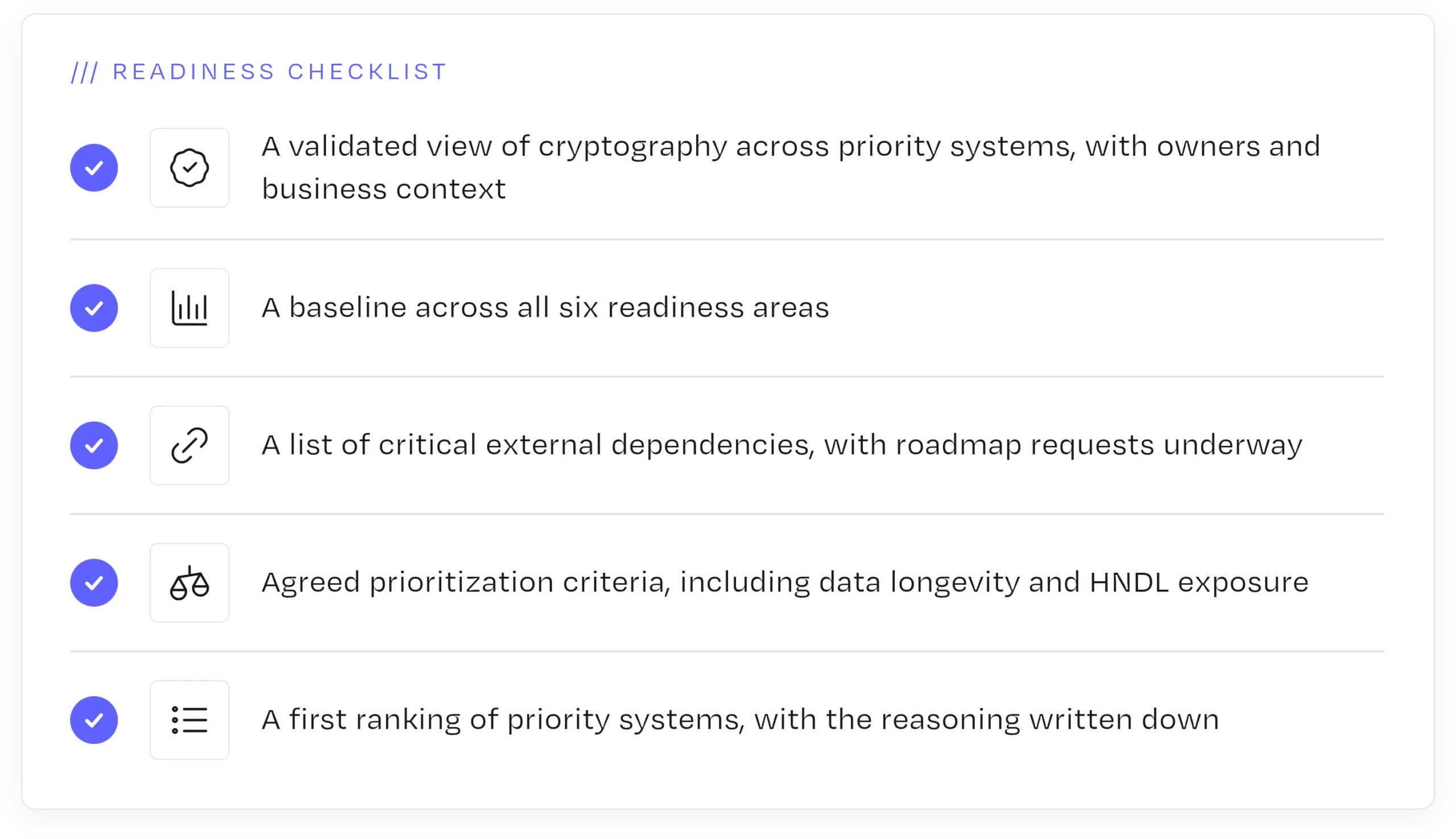
Use this checklist to confirm you’re ready for Stage 3:
- A validated view of cryptography across priority systems, with owners and business context
- A baseline across all six readiness areas
- A list of critical external dependencies, with roadmap requests underway
- Agreed prioritization criteria, including data longevity and HNDL exposure
- A first ranking of priority systems, with the reasoning written down
From there, the next step is turning insight into priorities. Further out, the same discovery work supports continuous resilience, where you can change algorithms again without disruption.
Moving forward: turn the inventory into a PQC readiness baseline
An inventory tells you what you have. A baseline tells you how ready you are to act on it. A useful baseline looks across six connected areas:
- Program ownership
- Cryptographic observability
- Risk prioritization
- Ecosystem readiness
- Testing and transition
- Operational governance
Measuring all six matters because they depend on each other. Strong discovery can’t carry a program without an owner, and a clear owner can’t prioritize without data.
The Keyfactor PQC readiness assessment benchmarks these areas with six questions. Each area is scored on five levels, and your stage is determined by the median score and guardrails. Those guardrails keep progress in one area from masking a missing foundation in another.
Your result includes a stage, a six-area breakdown, and three focus areas. Treat the focus areas as starting points rather than a prescribed migration plan. Learn more about how the PQC readiness assessment works.

PQC READINESS ASSESSMENT
How ready is your cryptography, really?
Resources to go deeper on PQC discovery and planning
These Stage 2 resources go further on inventory, discovery, and posture management. Find all three in the Keyfactor PQC Lab.
- Inventario criptográfico: Obtener valor hoy, prepararse para mañana
- Keyfactor AgileSec: Hunting for Weak Cryptography
Explore the PQC readiness series
- The five stages of PQC readiness
- Stage 1: Awareness and Alignment
- Stage 2: Discovery and Planning (you’re here)
- Stage 3: Risk Prioritization
- Stage 4: Agility and Automation
- Stage 5: Resilience
- How the PQC readiness assessment works
- The Keyfactor PQC Lab
How Keyfactor can help with Stage 2 discovery and planning
Keyfactor AgileSec provides continuous cryptographic discovery across network endpoints, hosts, source code, artifact repositories, and the systems that manage keys and certificates. It builds a continuously updated system of record, with quantum-vulnerable assets mapped for phased migration planning.
That’s the inventory baseline Stage 2 needs, kept up to date as your environment changes. AgileSec integrates with the security and infrastructure tools you already use.
Want help connecting results to your environment? Take the PQC readiness assessment, then choose Talk with a PQC expert. A Keyfactor PQC expert can answer questions about discovery, prioritization, testing, and migration.
When you’re ready for hands-on tools and demos, explore the PQC Lab.
A clear picture is the start of a real PQC plan
Stage 2 turns awareness into a roadmap. Visibility shows what you have, dependencies show what’s outside your control, and criteria show what moves first.
Put those three pieces together, and your migration plan rests on evidence. Start by seeing where you stand today: six questions, about two minutes.
Next in the series: Stage 3: Risk Prioritization
Preguntas frecuentes
Got PQC readiness questions? We’ve got answers.
Suscríbase a The Source
Stay secure with Keyfactor's monthly newsletter, packed with expert insights and practical steps for quantum-readiness.
Continuar leyendo
Keyfactor y Quantinuum anuncian una integración para ayudar a las organizaciones a avanzar en su preparación postcuántica
Leer más
PKI poscuántica: una guía práctica de preparación para los equipos de seguridad de las empresas
Leer más