EJBCA SaaS PKI est désormais disponible sur Microsoft Azure




It’s no secret that organizations rely heavily on public key infrastructure (PKI) and machine identities to securely build, deliver, and run applications. Historically, Active Directory Certificate Services, also known as Microsoft CA, has been the de facto PKI choice for organizations — it’s well integrated into the Microsoft infrastructure and supports standard use cases.
However, as companies shift to hybrid and multi-cloud environments with Azure and Active Directory (AD), traditional on-premise Microsoft CAs simply cannot support their migration.

Traditional PKI wasn’t built to handle the volume and velocity of certificate usage today, which spans from web servers and load balancers to mobile and IoT devices, and increasingly, CI/CD tools and cloud-based infrastructure.
Plus, there are additional roadblocks for organizations to navigate:
- Operational challenges: Microsoft CA only allows one CA per server. At a time when organizations need to issue new certificates from a variety of CAs on a daily basis, this creates an overly complex footprint at scale.
- Limited integrations: While Microsoft CA integrates well with on-premise Microsoft infrastructure, that’s where it ends. This lack of integration support doesn’t work well as organizations move to a multi-cloud environment.
- Lack of support: Microsoft is well aware of these limitations and is no longer actively supporting or developing Microsoft CA, meaning that the gap between the limitations of the solution and modern use cases will only continue to widen.
- Lack of flexibility: Traditional PKI is rigid and inflexible. Organizations need a modern PKI solution that can be deployed how and where they need it, whether it’s on-premise or in the cloud, fully managed or self-hosted.
Without a cloud-based PKI, organizations struggle to stretch their existing PKI deployment during migration, often to its breaking point. The good news is there’s a clear path to a modern PKI in the cloud.
Modernisez votre PKI: Migrer vers Microsoft Azure avec EJBCA SaaS
Aujourd'hui, nous sommes ravis d'annoncer la dernière étape de Keyfactordans la fourniture de solutions de sécurité qui stimulent l'innovation dans les environnements d'entreprise modernes - EJBCA SaaS sur Microsoft Azure.
EJBCA SaaS est une autorité de certification flexible, évolutive et indépendante de la plateforme qui prend en charge les cas d'utilisation sur site, hybrides et multicloud PKI . Disponible sur Azure Marketplace, elle permet aux utilisateurs d'accélérer en toute sécurité la migration vers le cloud en authentifiant les identités numériques à l'aide de PKI.
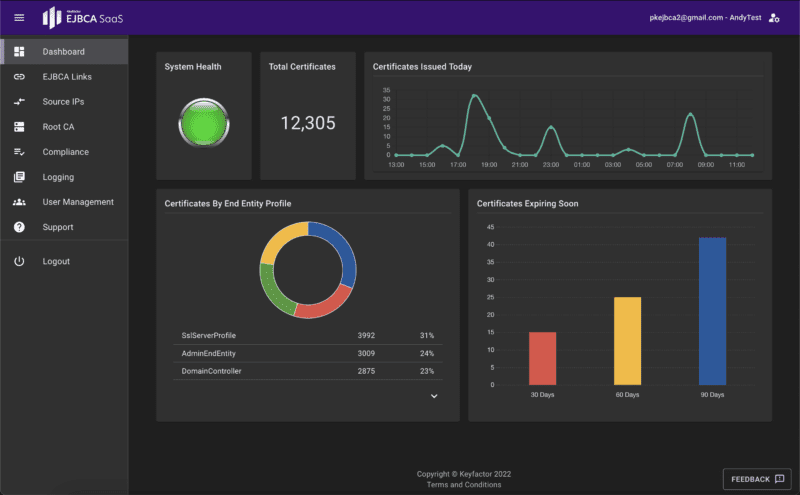
Les principales caractéristiques et avantages sont les suivants :
- Simplify PKI: Reduce the effort and expense of deploying and maintaining PKI internally. Underlying CAs, HSMs, and infrastructure are hosted and managed by Keyfactor experts.
- Support any use case: Integrate with your existing Active Directory (AD) or Azure AD, and support any platform with multiple protocols and interfaces, including ACME, SCEP, EST, CMP, REST API, and more.
- Deploy fast, run anywhere: Deploy in virtually any Azure region in no time, with integrations to Azure Key Vault and Azure Managed HSMs for key protection.
- Scale on-demand: Meet increasing demands with an unlimited number of CAs, automated scaling, and support for high availability and redundancy — only paying for what you use.
- Self-service control: Manage and control your PKI from a single SaaS portal. Start and stop a dedicated root CA, add networks, configure logging, and more.
Vous voulez en savoir plus ?
- En savoir plus sur EJBCA SaaS PKI
- Démarrer avec EJBCA SaaS sur Azure
- Inscrivez-vous dès maintenant à notre prochain webinaire pour assister à une démonstration en direct de EJBCA SaaS sur Azure.
S'abonner à La Source
Stay secure with Keyfactor's monthly newsletter, packed with expert insights and practical steps for quantum-readiness.
Lire la suite

Comment définir la période de validité de PKI et les meilleures pratiques en matière de révocation ?
En savoir plus
Préparez-vous pour Post Quantum avec les nouvelles capacités EJBCA et SignServer
En savoir plus