




“The threat isn’t the arrival of quantum computing – it’s the assumption that you still have time.”
In financial services, the infrastructure behind digital trust is cracking under pressure. Now, another shift is forcing security leaders to confront a deeper challenge: post-quantum cryptography (PQC).
Let’s be honest. PQC sounds like another “security problem to figure out later.” But the real risk isn’t waiting for quantum to break your encryption – it’s failing to prepare before regulators and customers ask you if you’ve already started.
Let’s unpack the “why now,” the potential damage, and a roadmap you can act on – before your organization finds itself reacting too late.
Une faille quantique en 2025 ? Voici à quoi cela pourrait ressembler
Imagine this scenario:
- A malicious actor has been quietly harvesting encrypted data from your organization’s cloud backups for months.
- Vous avez réussi votre audit. Tout se présente bien.
- En 2030, l'informatique quantique franchit le seuil de la cryptographie - soudain, chacun de ces fichiers cryptés est lisible.
- Les données volées comprennent des journaux de transactions, des paquets d'identité de clients et des communications confidentielles entre systèmes.
- You notify regulators, but they want to know why you had no migration plan, despite years of guidance.
This isn’t a science-fiction thriller. It’s what NIST and financial regulators call a “harvest-now, decrypt-later” attack, and why guidance on how to address these and other quantum threats is already out there and being implemented by the world’s largest banks.
In other words, quantum risk has already begun. And the audit trail? That’s being written right now.
Mais le Quantum n'est-il pas encore à 5-10 ans ?
Yes – and that’s exactly the point. You need that time to prepare.
Just like digital transformation wasn’t about doing everything overnight, PQC readiness is about making forward-compatible moves now so your infrastructure doesn’t need a ground-up overhaul later.
From the Security Leader’s Digital Trust Playbook:
“The real deadline for post-quantum isn’t when the tech arrives. It’s when auditors and regulators begin asking how you plan to protect data that lives beyond the crypto shelf life of today’s algorithms.”
Spoiler: Auditors and regulators already are.
- NIST has selected its first post-quantum algorithms.
- The FDIC issued PQC guidance for financial institutions in late 2023.
- Les régulateurs de l'UE ont fait référence à la crypto-agilité dans le langage d'application de la loi DORA.
La crypto-agilité est synonyme de préparation.
Crypto-agility isn’t a buzzword—it’s your bank’s ability to swap cryptographic algorithms quickly and confidently, without downtime or risk.
That starts with visibility: You can’t migrate what you can’t see.
In our recent research, less than 25% of FinServ organizations could accurately inventory where vulnerable algorithms like RSA and ECC are used across:
- TLS connections
- App-level signing mechanisms
- Service mesh authentication
- Customer APIs
- Developer toolchain
If your infrastructure is full of hardcoded cryptography – and no one knows who owns what – you’ve already lost.
Une feuille de route en 4 étapes pour la préparation à l'après-quantique
Here’s a simplified version of what we recommend in our full digital trust playbook.
- Inventaire des biens cryptographiques
Discover every certificate, key, and signing process across all cloud, on-prem, and DevOps environments.
- Classer les risques liés aux algorithmes
Identify which assets use quantum-vulnerable algorithms (RSA, ECC) and prioritize based on lifespan and sensitivity.
- Établir des normes d'agilité cryptographique
Ensure new systems support hybrid certificates (classical + PQC), flexible policy enforcement, and automated renewal.
- Tests dans des environnements à faible risque
Don’t wait for a sweeping migration. Start with controlled use cases, like code signing or internal APIs, where you can test PQC readiness safely.
Mettez la main à la pâte avec Keyfactor
Keyfactor is trusted because our experts don’t just scan your environment and hand you a slide deck. We help you:
- Build a working crypto-inventory
- Identify shadow or rogue certs
- Deploy hybrid certs that support PQC
- Create audit-ready evidence of crypto-agility
We’ve helped global banks start their journey without disruption – and without breaking the tools they already use.
De la confiance à la transformation
In Blog 1 in our special series devoted to financial services, we covered how digital trust has become a foundation for growth, especially during M&A and DevOps expansion. But PQC forces us to think bigger.
Et voici ce qu'il faut retenir : Les banques qui gagneront demain sont celles qui se préparent dès maintenant.
📥 Want the full roadmap now?
Curious what preparation looks like? Download The Security Leader’s Digital Trust Playbook: Financial Services Edition today.
Vous avez des questions à poser à notre équipe de sécurité ? N'hésitez pas à nous contacter ici - nous sommes là pour vous aider !
S'abonner à La Source
Stay secure with Keyfactor's monthly newsletter, packed with expert insights and practical steps for quantum-readiness.
Lire la suite
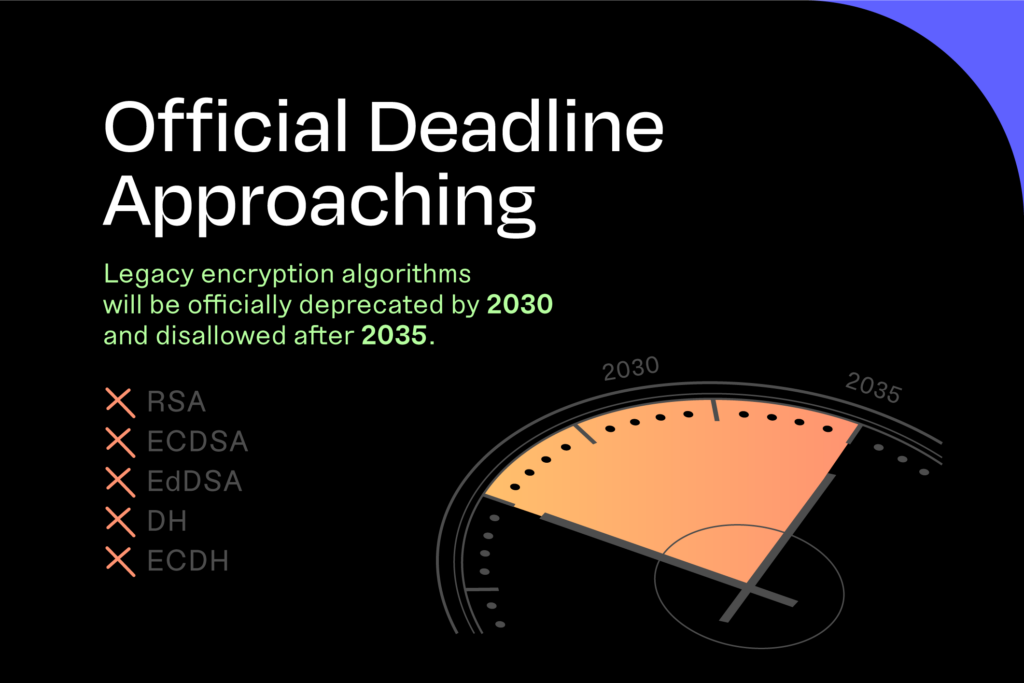
Le NIST abandonne une nouvelle échéance pour la transition vers le CQP
En savoir plus
Le gouvernement vient de fixer une échéance pour l'informatique quantique. Voici ce que cela signifie concrètement pour vous.
En savoir plus