



Live fast. Expire young. The curse isn’t accidental. It’s policy.
Certificate lifespans are shrinking. What once lasted a year now lasts months — and soon, just 47 days.
In fact, the first milestone of the CA/Browser Forum’s plan to reduce TLS certificate lifespans has already come and gone. As of March 15, 2026, maximum lifespans dropped to 200 days. Next year, 100. In another two — 47.
At first glance, shorter certificate lifetimes sound like a straightforward security improvement:
- Reduce exposure
- Limit the window of compromise
- Strengthen cryptographic hygiene
- Improve overall security posture
But as the cadence compresses, something deeper is happening. Policy is beginning to move faster than many organizations are structured to operate.
 A beloved hero returns to the scene to help navigate this turbulent time:
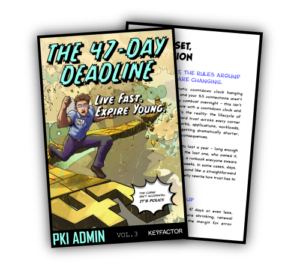
PKI Admin embarks on yet another adventure in The 47-Day Deadline: Live Fast. Expire Young., the third installment of Keyfactor’s comic book series. Part satire. Part survival guide. Entirely too relatable.
Because the shift to short-lived certificates isn’t theoretical.
It’s structural.
And whether your organization feels it yet or not — it’s already underway.
The Shift to 47-Day Certificates Is Structural — Not Temporary
The move toward shorter certificate lifespans isn’t random. It isn’t reactionary. And it isn’t going away.
- For executives and security leaders, this is a governance win.
- For operations teams, it’s a cadence shift.
Renewals that historically occurred once per year will now occur eight times as often. Approval cycles, deployment workflows, and ownership models that were designed for long-lived certificates are suddenly under constant pressure.
Nothing may break immediately. In fact, the early phase often looks deceptively calm.
But the math is already changing.
When Enforcement Speeds Up, Everything Else Must, Too
Certificate policy doesn’t wait for someone to return from vacation.
It simply enforces the rules — consistently, predictably, and without exception.
And that consistency is not the problem. In fact, policy is doing exactly what it’s meant to do: reduce risk and protect digital trust.
The tension arises when the systems around it, like —
- Ticket queues
- Manual approvals
- Spreadsheet tracking
- Fragmented ownership
— move slower than enforcement.
When certificates renew more frequently:
- Manual processes multiply
- Renewal windows overlap
- Small delays compound
- Accountability blurs
What once required occasional coordination now demands continuous orchestration. And that’s where many organizations feel the strain.
The Hidden Risk: Heroics Don’t Scale
Once, experience and quick reaction times could compensate for structural inefficiencies.
When certificates expire every 47 days, relying on individual heroics becomes unsustainable. The issue isn’t skill. It’s speed.
This is why many organizations are discovering that:
- Experience does not equal readiness
- Compliance does not equal operational resilience
- More alerts do not equal more control
The shift to 47-day certificates is exposing operating models that were never designed for continuous lifecycle motion.
Policy Isn’t the Villain — It’s the Forcing Function
It may feel like policy is the antagonist in this story.
But it isn’t.
Policy is the forcing function that pushes organizations toward stronger digital trust infrastructure.
The real challenge isn’t policy. It’s misalignment.
If policy operates at machine speed, certificate management must operate at machine speed, too.
That means:
- Continuous visibility into certificate inventory
- Automated renewal and deployment workflows
- Clear lifecycle ownership across teams
- Systems designed for cadence, not calendar reminders
When the operating model catches up, the chaos fades.
The Executive Reflection: Are We Designed for Enforcement Speed?
Like any classic comic, there’s a scene where the hero realizes brute force won’t win the day.
We’ve hit that inciting incident. Cue the moment of reflection…
For today’s business and security leaders, the reflection isn’t in a puddle or a polished skyscraper window — it’s in your operating model.
Are we structurally designed to move at enforcement speed?
Because in a 47-day world:
- Volume increases
- Margin for error shrinks
- Manual delay becomes risk
- Digital trust becomes more visible — especially when it fails
It’s not just a PKI team issue. Certificates underpin applications, workloads, APIs, devices, and customer-facing systems.
Certificate lifecycle management is now shared infrastructure. And infrastructure must scale.
From Expiration Events to Lifecycle Agility
The organizations that thrive in this shift don’t treat renewals as isolated events.
They design for lifecycle agility.
Lifecycle agility means:
- Managing certificates as continuous processes
- Building automation into the renewal path
- Replacing reactive heroics with predictable orchestration
- Aligning process speed with enforcement speed
When discovery replaces guesswork and automation replaces friction, shorter lifetimes stop being disruptive.
They become manageable.

Check out PKI Admin’s latest comic for a practical — and occasionally uncomfortably relatable — look at what happens when policy accelerates and organizations must adapt.
If you manage certificates, lead security teams, or oversee digital infrastructure, you’ll recognize the patterns. 👉 Download and read the full comic here.
For practical steps to scale certificate management and reduce outage risk, sign up for this three-part webinar series focused on the transition to47-Day Certificates. 👉 Register here.

Certificates will continue to live fast and expire young — by design. Policy will continue to enforce.
The only variable left is whether your systems are built to move at the same speed.
