In our third blog of the Forrester Total Economic Impact study series — check out the first blog on finding the real dollar value of PKI and second blog on 5 numbers that will change how you think about PKI— we are going to look at the words of our customers that tell the story beyond the numbers.
1. Do More with the Same Team
The assumption most IT and security leaders live with is that growth of any type requires more headcount. More certificates, more servers, and more identities lead to more engineers. That’s often true, until you start working more efficiently.
“Even though our certificate usage has increased over 10 times since adopting Keyfactor, our team has remained pretty steady. We’re actually leaner than when we started.”
— Project Manager, Information Security, Retail
A 10x increase in certificate volume, but with the same team, isn’t just an incremental efficiency gain; it’s a fundamental change in how certificate work gets done. When provisioning, renewal, and deployment are automated, growth stops being a staffing problem. The organization in question now has fewer than five internal resources focused on certificate-related work, fewer than before Keyfactor, despite managing an order of magnitude more certificates.
For security leaders facing pressure to do more without expanding headcount, this is the math that changes the conversation.
2. Infrastructure: the Hidden Cost Nobody Talked About
It’s hard to see the cost that’s been quietly accumulating for years: servers that need patching, firewalls that need maintaining, systems admins whose calendars are full of work that adds no strategic value.
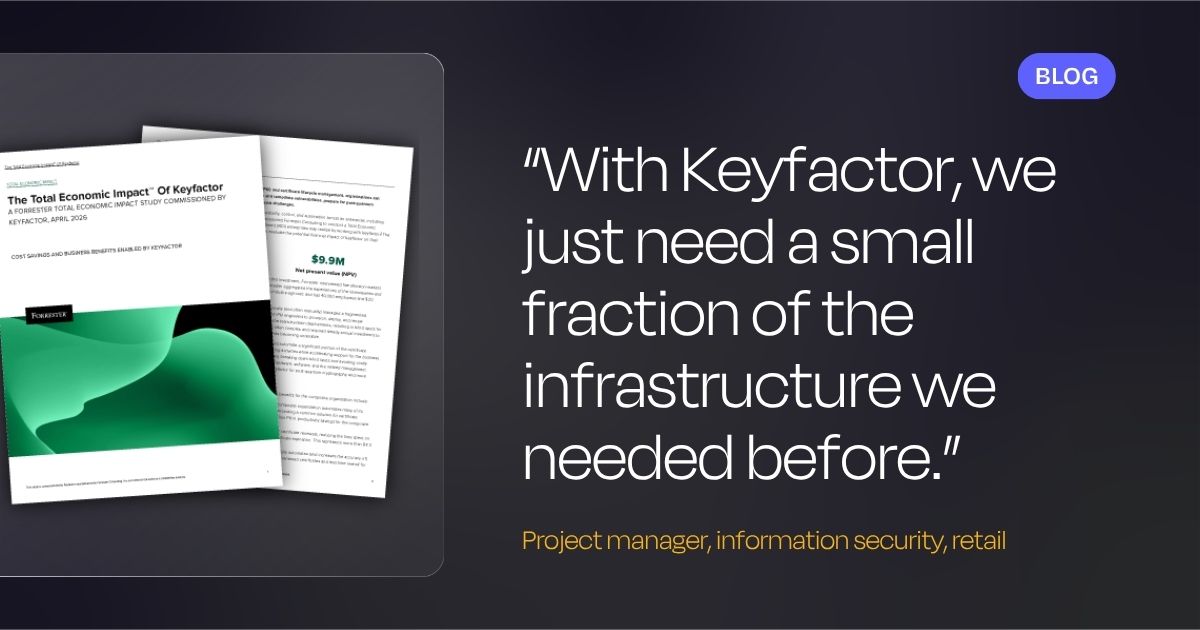
“With Keyfactor, we just need a small fraction of the infrastructure that we needed before.”
— Project Manager, Information Security, Retail
This telecommunications organization had built up a PKI infrastructure footprint of more than 70 CA servers over many years as a direct result of independently managed, private certificates accumulating without a unified platform to consolidate them. The cost wasn’t just the hardware. It was the people managing it, the ongoing patching and maintenance, and the growing operational burden of a sprawling PKI environment with limited visibility.
Moving to Keyfactor’s SaaS-delivered PKI didn’t just reduce infrastructure costs, it eliminated an entire category of operational burden. The Forrester study found that organizations can reduce PKI infrastructure costs by 65% to 95% over three years — representing more than $1.4 million in present value savings.
3. Preventing the Unplanned Outages
Certificate expiration outages are the kind of incident that feels entirely preventable in hindsight, yet constantly happen in organizations without centralized visibility. The consequences range from minor internal disruptions to customer-facing outages costing hundreds of thousands of dollars per hour.
“With Keyfactor, we’ve only had one minor [outage] incident in five years.”
— Project Manager, Information Security, Retail
With no organization-wide tracking, no standardized renewal process, and no early warning system, outages were a matter of when, not if.
That changed with centralized visibility and automated renewals. The Forrester study modeled a 95% reduction in certificate-related incidents by Year 3 for the average organization. Using an average cost of $100,000 for each avoided incident, the result was more than $3.6 million in present value from incident reduction alone. The takeaway is clear: outages don’t have to be inevitable, and the savings are immediate.
4. Your Best People Shouldn’t Be Systems Admins
There’s a hidden talent cost in manual certificate management that rarely shows up in a budget line. The engineers who are technically skilled enough to automate the future are spending their days on manual, operational tasks that belong in the past.
“We had many engineers that were exclusively managing the [certificate] lifecycle and not doing anything else. Now those engineers are focusing on security, on compliance, and working with our business partners on truly automating the certificate lifecycle.”
— SVP, Director of Security and Network Infrastructure, Banking
Before Keyfactor, certificate provisioning, renewal, and deployment at this bank were handled at the application team level — fragmented across many teams and nearly 100 individuals. The SVP described it directly: certificate management didn’t add value to the business. It consumed it.
Keyfactor didn’t just save hours; it redirected them. Engineers who were functioning as glorified systems admins are now doing strategic integration work. Forrester quantified this reallocation across provisioning, renewal, and deployment as more than $7.5 million in combined labor savings (present value) for the composite organization over three years. Moreover, now your best security talent is finally working on security.
5. The Clock Is Already Ticking on Post-Quantum
The organizations managing certificate estates today aren’t just preparing for today’s threat landscape. They’re inheriting tomorrow’s compliance requirements: shorter certificate lifespans, quantum-resilient algorithms, and intensifying regulatory scrutiny. The question isn’t whether these changes are coming; it’s whether your infrastructure will be ready when they arrive.
“Keyfactor is one of the key contributors for post-quantum algorithm support. They are also watching how the industry is trending with the short-term certificate durations and building systems to support crypto agility in this ecosystem. Keyfactor’s constant involvement in the industry means I’m confident that by 2029, when the industry converges on both of these, we will be riding the wave where the industry is heading and not lagging behind.”
— Principal Security Engineer, Software
By 2029, public TLS certificates will require renewal every 47 days. Post-quantum cryptography standards are moving from guidance to mandate. For organizations still managing certificates manually, or across fragmented, team-by-team tooling, the operational burden of these changes will be enormous.
For organizations already on Keyfactor, it’s a matter of configuration, not crisis. That’s the difference between a platform and a tool: one scales with the industry, the other requires you to catch up to it.
The Bottom Line
Five customers, from five industries, with five entirely different problems — infrastructure bloat, outage frequency, talent misallocation, scalability, and future readiness. But one platform addressed all of them.
The Forrester TEI study found an average organization realizes $12.7 million in benefits over three years against $2.8 million in costs, for a 356% ROI and payback in under six months. But the quotes above capture something the financial model can’t fully express: what it feels like when chronic operational problems become business opportunities.
To explore the full findings, read the complete Forrester Total Economic Impact™ study commissioned by Keyfactor.