What if there were a way to turn PKI from a necessary cost into a measurable business advantage?
What if you could answer questions like:
- How much time are we actually wasting managing certificates by hand?
- What’s the real cost of a certificate outage – or the risk of the next one?
- When will automation pay for itself?
And what if those answers didn’t come from marketing claims or back-of-the-napkin math, but from an independent, third-party economic analysis?
That’s exactly what a Forrester Total Economic Impact™ (TEI) study is built to do.
More on that below 👇
Trust Matters – But Proof Matters More
Public key infrastructure (PKI) isn’t often in the spotlight, but without the right solution, it can be a showstopper (and not the good kind).
PKI isn’t something executives wake up thinking about, but it’s essential to everyday business operations. Without it, connections couldn’t be authenticated, code couldn’t be verified, and data would be left unprotected as it travels the infinite expanse of networks we rely on.
Certificate outages, compressed lifecycles, and cloud-native complexity have changed the conversation. PKI has moved from “invisible” infrastructure to a highly visible risk management concern. Put another way, PKI has become a single point of failure – and that’s exactly why so many organizations are now evaluating PKI as a business platform.
Today, PKI investments are under the same scrutiny as any enterprise platform. Budgets are tighter. Boards want justification. CFOs want defensible numbers. And “we need it for security” is no longer a sufficient business case.
In a world of shrinking margins for error, “trusted” isn’t good enough. PKI modernization now requires proof.
Why Enterprises Are Rethinking PKI
For years, PKI and certificate management was treated as a necessary cost of doing business.
Certificates were issued, renewed, and replaced largely through manual processes, with little visibility into the true cost of managing digital certificates or the operational risk tied to them. But as certificate lifespans shrink and cloud environments scale, that model is breaking down fast. PKI became more complex as certificate volumes grew, requiring more infrastructure, more policy and control, and more day to day maintenance to keep up.
Most PKI environments weren’t designed for today’s reality. They grew organically – one self-signed certificate here, another tool there – until organizations found themselves with:
- Thousands (or millions) of certificates
- Multiple certificate authorities and PKI tools
- Manual renewal processes
- Limited visibility across teams and environments
The challenge isn’t that PKI is inherently expensive – it’s that most organizations don’t see where the costs actually come from.
These costs rarely appear on a single line item. Instead, they show up as:
- Engineering hours lost to manual, tedious processes
- Revenue impact from certificate‑related outages
- Security risk introduced by human error
- Delayed initiatives because PKI doesn’t scale fast enough
PKI becomes expensive because of inefficiency, risk, and constant firefighting.
When PKI runs smoothly, no one notices. When it doesn’t, the impact is immediate: outages, failed transactions, security incidents, and broken customer experiences.
Knowing what can be trusted, where, and for how long now depends entirely on machine identities – and the PKI systems that manage them.
Meanwhile, the lifespan of publicly-trusted TLS certificates is rapidly shrinking, moving toward 47‑day renewals by 2029. This means trust is no longer static. It must be continuously established, validated, and renewed.
This shift fundamentally changes how PKI must operate – and how it must be evaluated. When certificates must be issued, rotated, and replaced at machine speed, inefficiency and risk compound quickly.
Manual vs. Automated PKI: A Cost and Risk Divide
The difference between manual vs. automated PKI? Follow the money…organizations that rely on manual certificate management struggle to scale without adding headcount, increasing risk, or accepting downtime as inevitable.
Every missed renewal creates a potential outage. Every outage introduces revenue loss, reputational damage, and emergency remediation costs.
By contrast, certificate lifecycle automation changes the economics of PKI. Automation reduces renewal failures, improves visibility, and lowers the effort required to manage certificates across hybrid and multi-cloud environments. This is where certificate lifecycle automation ROI becomes measurable – not just in time saved, but in PKI risk reduction and certificate outage prevention.
For many enterprises, the business case is becoming clear: PKI automation ROI is no longer theoretical. It’s driven by the ability to reduce PKI operating costs, minimize outages, and regain control over an increasingly critical trust layer.
In a future where certificates must be renewed every 47 days – or less – manual processes and legacy PKI models simply cannot keep pace.
The challenge is no longer just issuing certificates. It’s sustaining trust at machine speed.
Why PKI Modernization Is a Business Conversation Now
As organizations modernize infrastructure, adopt cloud‑native architectures, and prepare for emerging threats like post‑quantum cryptography, PKI has moved from the background to the boardroom.
Instead of asking whether PKI is necessary, executives are asking:
- How resilient is our digital trust infrastructure?
- What happens if certificates fail at scale?
- Are we over‑relying on manual processes?
- What is the real cost of maintaining PKI the way we do today?
That’s why you must be able to translate PKI outcomes into business and risk-management terms executives recognize.
What a Forrester Total Economic Impact™ Study Brings to PKI
A Forrester Total Economic Impact™ study was designed to quantify the economic, operational, and risk-reduction impact of a technology investment over time.
A commissioned study conducted by Forrester Consulting on behalf of Keyfactor evaluated the experience of a composite organization, based on interviews with customers, to examine:
- Benefits realized over time
- Costs to deploy and operate
- Risks and uncertainty, adjusted conservatively
- Financial outcomes such as ROI, payback period, and net present value
The goal of the study was not to determine whether a product was “best,” but to provide a structured economic framework to help decision-makers evaluate whether an investment delivered value.
Why Independent Economic Analysis Matters
Security teams understand the importance of PKI intuitively. Executive teams, however, are responsible for weighing PKI alongside other sources of enterprise risk and investment.
Independent economic analysis bridges that gap by providing a consistent framework for evaluating cost, risk, and operational impact, grounded in the results of the composite organization modeled in the study.
To help quantify the business impact of modern certificate management, Keyfactor commissioned Forrester Consulting to conduct a TEI study.
The goal: provide a clear financial framework organizations can use to evaluate the potential value of automating and centralizing PKI with Keyfactor.
Forrester interviewed five organizations and modeled a composite enterprise with 40,000 employees and $20 billion in annual revenue.
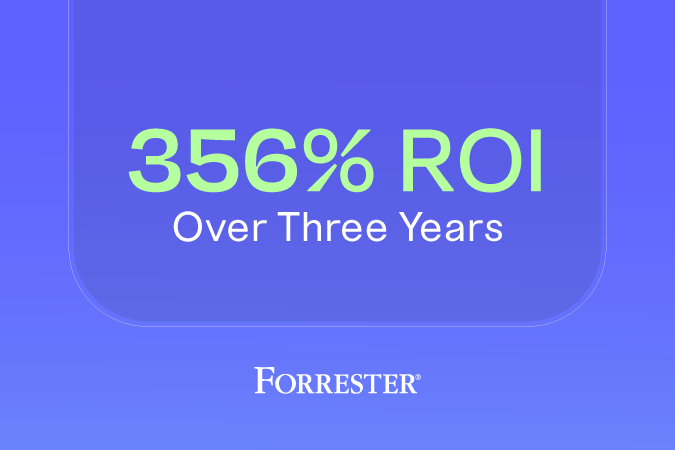
The findings were significant: a 356% return on investment and $9.9 million in net present value over three years.
More importantly, the study illustrates how improved visibility, automation, and infrastructure modernization translate into measurable business outcomes. Let’s dive into the figures:
→ Cost Savings and Total Cost of Ownership
Before Keyfactor, certificate management was fragmented, manual, and expensive to maintain. Teams worked in silos. Engineers handled repetitive tasks. Infrastructure costs kept climbing.
After automation, the economics shifted.
Over three years, the composite organization realized $9.9 million in net present value, reduced PKI infrastructure costs by up to 95% by Year 3, and saved up to 12,000 hours on certificate provisioning alone, with additional efficiency gains across renewals and deployment.
Centralized visibility and automation changed the cost model entirely.
→ Risk Reduction and Business Continuity
Certificate outages aren’t theoretical. They’re disruptive, visible, and costly.
With limited visibility, the composite organization faced expiration risks and security blind spots. After implementing Keyfactor, certificate-related incidents dropped by 95%.
That means fewer outages. Fewer fire drills. Fewer customer-facing disruptions.
Full visibility also eliminated rogue and shadow certificates, strengthening overall security posture and reducing potential attack vectors.
PKI moved from reactive problem to proactive risk control.
→ Operational Efficiency Through Automation
Let’s do the automation math now: the composite organization eliminated up to 12,000 manual provisioning hours, significantly reduced renewal effort per certificate, and freed highly skilled PKI engineers to focus on higher-value initiatives.
Instead of chasing expirations, teams supported the business faster – and prepared for shorter certificate lifecycles and post-quantum change.
→ Time to Value
The study found a 356% ROI over three years – with a rapid payback period.
This isn’t a slow-burn optimization project. Certificate automation can deliver measurable financial and operational impact within the first year.
For organizations under pressure to prove value, that speed matters.
Explore the Full TEI Study Now
PKI has always been essential to digital trust. What’s changed is the expectation around accountability.
Modern organizations can no longer afford to manage PKI as an implicit or assumed risk. Managing PKI now requires the same rigor applied to other sources of enterprise risk. They need visibility, automation, and evidence that their investments reduce risk and deliver measurable value.
Download the full Forrester Total Economic Impact™ study to explore the full methodology, detailed financial model, and risk-adjusted findings.